Anthony Pritchard
Active Member
Where Faith Prevails and Determinism Fails
From the foundation of the world, the Lamb was slain. This is not poetic hyperbole, it is divine reality. Revelation 13:8 declares, “And all that dwell upon the earth shall worship him, whose names are not written in the book of life of the Lamb slain from the foundation of the world.” Christ’s sacrifice was not reactive but preordained, a sovereign act of redemption that precedes time itself.Isaiah echoes this eternal foresight: “Declaring the end from the beginning, and from ancient times the things that are not yet done, saying, My counsel shall stand, and I will do all my pleasure” Isaiah 46:10. God’s omniscience is not passive observation, it is active orchestration. The table, then, is set: Christ slain, the Book of Life opened, and every soul conceived already known.
Foreknowledge Is Not Forewill
To know a thing beforehand is not to cause it. I know the sun will rise tomorrow, but I do not cause it to rise. So too, God’s foreknowledge of who will believe does not mean He decreed their belief. Calvinism confuses foreknowledge with forewill, turning divine omniscience into fatalistic determinism. But Scripture never teaches that God’s knowing equals God’s forcing.
Overcoming and the Book of Life: The Prerequisite of Eternal Life
Revelation 3:5 presents both a promise and a warning: “He that overcometh, the same shall be clothed in white raiment; and I will not blot out his name out of the book of life, but I will confess his name before my Father, and before his angels.” Only the overcomer retains his name in the Book of Life. But Scripture does not leave us to guess who the overcomer is.
John answers plainly: “For whatsoever is born of God overcometh the world: and this is the victory that overcometh the world, even our faith. Who is he that overcometh the world, but he that believeth that Jesus is the Son of God?” 1 John 5:4–5. The overcomer is not the morally superior but the spiritually reborn. To believe on Christ is to be born of God; to be born of God is to overcome. Salvation is not earned, it is received. And once received, it cannot be revoked.
The Book of Life: Written from Conception
If only the overcomer’s name remains, then whose names are blotted out? The biblical logic is both simple and beautiful: every soul conceived begins with their name written in the Book of Life. This aligns perfectly with God’s stated desire “for all men to be saved, and to come unto the knowledge of the truth” 1 Timothy 2:.
God’s heart is not selective but sacrificial. Peter writes, “The Lord is not slack concerning his promise… but is longsuffering to us-ward, not willing that any should perish, but that all should come to repentance” 2 Peter 3:9. The blotting out is not God’s desire, it is man’s rejection. The Book of Life begins full; it is diminished only by unbelief.
Triply Sealed
Salvation rests on three unshakable pillars.
First, the name of the overcomer cannot be blotted out. Christ promises, “I will not blot out his name out of the book of life” Revelation 3:5. The statement is future, emphatic, and unconditional.
Second, the new man cannot sin. John writes, “He cannot sin, because he is born of God” 1 John 3:9. Death comes by sin, and the new man cannot sin; therefore, he cannot die. Paul affirms, “For ye are dead, and your life is hid with Christ in God” Colossians 3:3. What is hidden in Christ cannot be lost.
Third, the believer is sealed by the Spirit. “In whom also after that ye believed, ye were sealed with that holy Spirit of promise, which is the earnest of our inheritance until the redemption of the purchased possession” Ephesians 1:13–14. The Spirit is not a temporary visitor; He is the down payment of eternity.
Romans 9: Misread by Calvinism, Misused by Determinism
Calvinists often cite Romans 9 as the cornerstone of unconditional election and reprobation. They point to verses like, “Hath not the potter power over the clay, of the same lump to make one vessel unto honour, and another unto dishonour?” Romans 9:21. And again, “What if God, willing to shew his wrath, and to make his power known, endured with much longsuffering the vessels of wrath fitted to destruction?” Romans 9:22.
But the key phrase is “What if…”, a rhetorical device, not a doctrinal decree. Paul is not declaring that God arbitrarily creates some for damnation. He is posing a hypothetical to highlight God’s sovereign patience, not His deterministic cruelty.
The vessels of wrath are not described as being fitted by God. The verb is passive. It does not say “whom He fitted for destruction.” The vessels are described as already fitted, implying they became so by their own rebellion.
This aligns with Pharaoh’s story. Exodus 8:15, 8:32, and 9:34 show that Pharaoh hardened his own heart. Only after repeated rejection does Scripture say, “the Lord hardened Pharaoh’s heart.” God’s hardening is judicial, not arbitrary. Pharaoh rejected God first. Then God used Pharaoh’s rebellion to display His glory. This is not predestined damnation, it is divine justice responding to human defiance.
The New Man: Born of God, Not of Adam
Scripture draws a sharp line between the old man born of Adam and the new man born of God. “Whosoever is born of God doth not commit sin; for his seed remaineth in him: and he cannot sin, because he is born of God” 1 John 3:9. This is not a denial of the believer’s struggle with the flesh, it is a declaration of spiritual identity. The new man, born of incorruptible seed, is incapable of sin and rebellion against God.
The new birth is not a moral improvement, it is a spiritual resurrection. “And you hath he quickened, who were dead in trespasses and sins” Ephesians 2:1. The new man is not merely forgiven; he is reborn, sealed, and sanctified.
Death Defined: Separation, Not Cessation
Death is not annihilation, it is separation. “For as the body without the spirit is dead, so faith without works is dead also” James 2:26. Physical death is the spirit separated from the body. Spiritual death is the spirit separated from God.
But the new man, born of God, is never separated. “Who shall separate us from the love of Christ?” Romans 8:35. The answer is no one and nothing. Death comes by sin, and the born again new man cannot sin, therefore cannot die, cannot return to his former self, dead in sins and trespasses.
Historical Refutation: Augustine and Calvin’s Inheritance
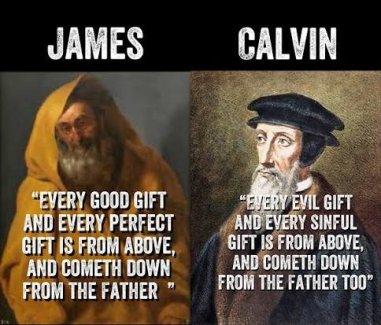
Long before Calvin, the debate was framed as predeterminism vs free will, God alone vs God and man together. Augustine, influenced by Neoplatonism and Manichaean fatalism, introduced deterministic fatalism into the Roman Catholic Church. For a time, Rome accepted it. But ultimately, the Roman Catholic Church rejected monergism, affirming human cooperation in salvation.
The Albigensians and other early sects held scattered predestinarian views, but they were never apostolic. Calvinism is not a return to primitive Christianity, it is a system built on Augustinian determinism, not on the teachings of Christ or the apostles.
Closing Exhortation
You are not a pawn in a cosmic lottery. You are known, loved, and sealed, not by decree, but by faith. If you have overcome, your name is written, your spirit reborn, and your inheritance secured. Calvinism offers a cold certainty built on exclusion. Christ offers eternal life built on invitation.
Natus ex Deo vincit - He who is born of God overcomes.
~Tony
© A.K. Pritchard 2024
Free to use with proper attribution.
Last edited: