
-
Welcome to Baptist Board, a friendly forum to discuss the Baptist Faith in a friendly surrounding.
Your voice is missing! You will need to register to get access to all the features that our community has to offer.
We hope to see you as a part of our community soon and God Bless!
You are using an out of date browser. It may not display this or other websites correctly.
You should upgrade or use an alternative browser.
You should upgrade or use an alternative browser.
Overcoming
- Thread starter Anthony Pritchard
- Start date

Ascetic X
Well-Known Member
What has been slanderous and incorrect?I have recently acquired "Spurgeon v. Hyper-Calvinism" by Iain Murray and yes, the book records the fits the hyper-Calvinists gave Spurgeon during the years of his ministry. I would just suggest that for those who keep insisting that you:
- that that is exactly what the Puritan era Calvinists did and that is why the preaching and ministry of Bunyan, Owen, Edwards and Spurgeon are of such value and excellence. That is what they did and as one who stumbled upon their writings mainly in sermon form and benefited greatly from doing so and only later, looked at the theology behind them while I can partially agree with the above statement as a caution, I would add that we might want to do the same thing with the Calvinists actual teaching and preaching - to the same common people the Bible was written to. That is, give them credit for plainly teaching the word of God in a manner that in my opinion has never been surpassed - instead of ignoring all that and repeating the charges of their enemies and/or reading the theological statements and applying your own interpretation as being what they really must have believed.
In other words, if you want to show me the gross errors of Calvinism, put up some examples of the Calvinist preachers that I read, Puritans, and later guys like Spurgeon, or Bonar, and I'll respectfully look at it and try to explain. If I can't then I will consider myself corrected and enlightened. But if you want to keep repeating slanderous and incorrect things you have heard on the internet as your only answer or, if you, having shown from other discussions, as having a very error prone sense of understanding plain scripture then I am not interested in such comments or explanations.

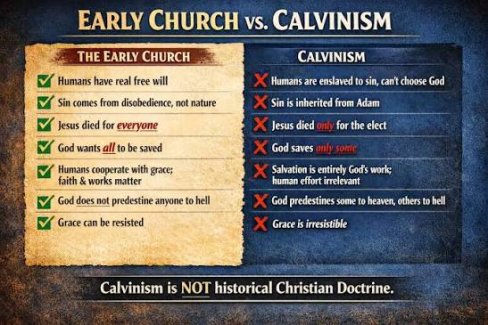
The "sin is inherited from Adam" (as opposed to "death spread to all men for all have sinned") came from post-Augustine Catholic doctrine. Augustine built a doctrine based on a Latin mistranslation which grew into the Catholic doctrine).
You are, of course, right. My post was an attempt at irony, but clearly it went astray. My point was that if you and @Ascetic X can be so wildly inaccurate about Calvinism and what it actually is, how can any of us have confidence in your understanding of the Bible?The absence of a word in Scripture does not invalidate the use of the word. The Bible never uses terms such as Bible, Trinity, omniscience, incarnation, millennium, or grandfather, yet we use these words to describe biblical truths and categories.
What I find ironic is that you and @JonC are always talking about just using the words of Scripture, and how wonderful it is to rely purely on that, and yet you can find no agreement and end up in a shouting match.Calvinism is simply a label for a theological system. Using a label to identify a system is simply clarifying what is being discussed. The question is not whether the word appears in the text, but whether the doctrines themselves align with the text, or not.
The fact is that the people who talk about 'just Scripture' are usually heretics. The JWs do it all the time. At the beginning of the 18th Century, there was a great upsurge in Unitarianism and those who were leading that insisted on only using the words of Scripture. BUt when people asked them what they understood by those words, they became very coy. I wrote an article on the subject and then putit on my blog. You can read it here: Learning The Lessons of History (1)

Learning the Lessons of History (2)
[Read first I am sure that I cannot be alone in seeing remarkable parallels between the early 18th Century and today. In our own time we have seen a marked decline in Christian orthodoxy and teac…
 marprelate.wordpress.com
@DaveXR650 recommended a fine book by Iain Murray, Spurgeon Vs. Hyper-Calvinism, published by Banner of Truth. I also recommend another book by the same author and publisher, The Forgotten Spurgeon. This book covers the 'Baptismal Regeneration' controversy of 1864, and also the 'Downgrade' controversy of Spurgeon's final years. But most interestingly for you, @Ascetic X and others is his defence of Calvinism against the wretched, diluted gospel fashionable in London in the 1850s.
Here is a very brief sample of Spurgeon's early preaching. His text was Galatians 1:15: 'It pleased God.'
'You will perceive, I think, in these words, that the divine plan of salvation is very clearly laid down. It begins, you see, in the will and pleasure of God: "When it pleased God." THe foundation of salvation is not laid down in the will of man. It does begin with man's obedience, and the proceed on to the purpose of God; but here is its commencement, here the fountain-head from which the living waters flow: "It pleased God." Next to the sovereign will and good pleasure of God comes the act of separation, commonly known by the name of election. This act is said in the text to take place even in the mother's womb, by which we are taught that it took place before our birth when as yet we could have done nothing whatever to win it or to merit it. God separated us from the earliest part and time of our being; and indeed, long before that, when as yet the mountains and hills were not piled, and the oceans were not formed by His creative power, he had, in His eternal purpose, set us apart for Himself. Then, after this act of separation came the effectual calling: "and called me by His grace"........'
I could not care less whether Calvinism is 'historical Christian Doctrine.' I will let you and the Roman Catholics worry about that.
I care that it is Biblical Christian Doctrine, which it most certainly is.

Anthony Pritchard
Active Member
Exactly. I’ve studied the early churches for years, and predestinarianism simply isn’t there. The first known instance of a church adopting anything like unconditional election or monergistic grace appears only in the North African Latin churches influenced by Augustine, beginning around 397–430 AD. That’s when Augustine developed and promoted his new doctrine of predestination.
Before Augustine, no church, Greek or Latin, held anything resembling later predestinarianism. That isn’t opinion; it’s the consensus of historical scholarship. The early fathers consistently taught real human freedom, universal atonement, and resistible grace. The shift toward determinism begins with Augustine, not with the apostles and not with the early churches.
Anthony Pritchard
Active Member
Martin, that response simply sidesteps the point. When a doctrine has no presence in the first churches, no presence in the apostolic communities, no presence in the Greek East, no presence in the Latin West before Augustine, and no presence in any creed or council for four centuries, it is entirely fair to ask why.I could not care less whether Calvinism is 'historical Christian Doctrine.' I will let you and the Roman Catholics worry about that.
I care that it is Biblical Christian Doctrine, which it most certainly is.
If a doctrine is truly “Biblical Christian Doctrine,” then the churches founded by the apostles, taught by the apostles, and discipled by the apostles should have held it. But they didn’t. Not one of them. The first church at Jerusalem didn’t teach it. The Greek churches never taught it. The Latin churches didn’t teach it until Augustine introduced it in the late 4th–early 5th century.
So the historical question matters because it exposes whether a doctrine is apostolic or post‑apostolic. Calvinism is post‑apostolic. It begins with Augustine, not with Scripture, not with the apostles, and not with the early churches.
You’re free to believe Augustine’s system if you want, but calling it “Biblical Christian Doctrine” requires more than asserting it. The burden is to show where the apostles taught it and where the churches they founded ever believed it. History shows they didn’t.
Ascetic X
Well-Known Member
Calvinists consistently deny the simple, clear statements of scripture.Martin, that response simply sidesteps the point. When a doctrine has no presence in the first churches, no presence in the apostolic communities, no presence in the Greek East, no presence in the Latin West before Augustine, and no presence in any creed or council for four centuries, it is entirely fair to ask why.
If a doctrine is truly “Biblical Christian Doctrine,” then the churches founded by the apostles, taught by the apostles, and discipled by the apostles should have held it. But they didn’t. Not one of them. The first church at Jerusalem didn’t teach it. The Greek churches never taught it. The Latin churches didn’t teach it until Augustine introduced it in the late 4th–early 5th century.
So the historical question matters because it exposes whether a doctrine is apostolic or post‑apostolic. Calvinism is post‑apostolic. It begins with Augustine, not with Scripture, not with the apostles, and not with the early churches.
You’re free to believe Augustine’s system if you want, but calling it “Biblical Christian Doctrine” requires more than asserting it. The burden is to show where the apostles taught it and where the churches they founded ever believed it. History shows they didn’t.
Hebrews 2:9
But we see Jesus, who was made a little lower than the angels for the suffering of death, crowned with glory and honour; that he by the grace of God should taste death for every man.
Calvinists: Every man does not mean every single man. It means only every elect man.
2 Corinthians 5:15
And that he died for all, that they which live should not henceforth live unto themselves, but unto him which died for them, and rose again.
Calvinists: Died for all does not mean everyone. It means all the elect only.
1 John 2:2
And he is the propitiation for our sins: and not for ours only, but also for the sins of the whole world.
Calvinists: The whole world does not mean everybody in the world. It means just the elect.
I Timothy 2
3 For this is good and acceptable in the sight of God our Saviour;
4 Who will have all men to be saved, and to come unto the knowledge of the truth.
Calvinists: All men does not mean every single man. It means only some men, who are the elect.