-
Welcome to Baptist Board, a friendly forum to discuss the Baptist Faith in a friendly surrounding.
Your voice is missing! You will need to register to get access to all the features that our community has to offer.
We hope to see you as a part of our community soon and God Bless!
You are using an out of date browser. It may not display this or other websites correctly.
You should upgrade or use an alternative browser.
You should upgrade or use an alternative browser.
Independent Baptist churches vs Anabaptists
- Thread starter 360watt
- Start date

DaveXR650
Well-Known Member
Do you know of an actual Anabaptist church or do you mean historically when they formed? I have some sources that claim some Anabaptist influence from one of the branches of the non-Calvinist early Baptists. And by that I mean the ones who trace their history to the Reformation. I am not referring to the claims some Baptists make of a direct lineage from the Anabaptists, which I believe is totally made up at least as far as written records.

It would be the non calvinist ifb churches. If they aren't Calvinist though.. how would they originate in the Reformation? They usually aren't Armenian either.Do you know of an actual Anabaptist church or do you mean historically when they formed? I have some sources that claim some Anabaptist influence from one of the branches of the non-Calvinist early Baptists. And by that I mean the ones who trace their history to the Reformation. I am not referring to the claims some Baptists make of a direct lineage from the Anabaptists, which I believe is totally made up at least as far as written records.
Armchair Apologist
Active Member
"Independent" Baptists make all sorts of sordid claims. Many adhere to "Baptist Perpetuity" that the Baptist Church is the "true church" in the same manner that Catholics claim that they are the true church.
Such "Trail of Blood" Baptists are wary of the "Reformed" crowd (they murdered Servetus after all) insisting they were never "Protestant" and never had anything to do with the "Great Whore" (Catholic Church) but in order to make such a claim, they need to claim affilliation with numerous spurious groups whose doctrines and teachings were questionable at best and heretical at worst. Their view of Church history is therefore quite skewed. There is also a good bit of "Restorationist" thinking (anti-creedalism) going on with this group.
While it goes without saying that the General Baptists (non-Calvinistic) were influenced somewhat by the Anabaptist movement, the two most certainly are no the same and there is little resemblance today between an Anabaptist congregation (Mennonite, Amish, Brethren, Etc.) and Independent Baptists or any Baptist for that matter. For starters, I do not believe that your average gun-toting, "Nuke 'em till they glow and shoot 'em in the dark" Independent Baptist would see eye-to-eye with the "turn the other cheek" pacifist Mennonite or Amish.
Such "Trail of Blood" Baptists are wary of the "Reformed" crowd (they murdered Servetus after all) insisting they were never "Protestant" and never had anything to do with the "Great Whore" (Catholic Church) but in order to make such a claim, they need to claim affilliation with numerous spurious groups whose doctrines and teachings were questionable at best and heretical at worst. Their view of Church history is therefore quite skewed. There is also a good bit of "Restorationist" thinking (anti-creedalism) going on with this group.
While it goes without saying that the General Baptists (non-Calvinistic) were influenced somewhat by the Anabaptist movement, the two most certainly are no the same and there is little resemblance today between an Anabaptist congregation (Mennonite, Amish, Brethren, Etc.) and Independent Baptists or any Baptist for that matter. For starters, I do not believe that your average gun-toting, "Nuke 'em till they glow and shoot 'em in the dark" Independent Baptist would see eye-to-eye with the "turn the other cheek" pacifist Mennonite or Amish.
DaveXR650
Well-Known Member
I would just echo what @Armchair Apologist said above. I think I have a copy of "Trail of Blood" from my days as an IFB. If you want to trace IFB's you simply don't have a path back to Anabaptists as far as I know. But you do have influences. I would look at this more as a fish net with various leaders and groups splitting off, and then their followers influencing other groups and leaders and some of them have later interactions with still others- some of which were of the groups which their teachers had split from and so on. For example, Menno Simons was a Catholic priest for years, and later came under some influence of Anabaptists but also was influenced by Luther, who had been a Catholic.It would be the non calvinist ifb churches. If they aren't Calvinist though.. how would they originate in the Reformation? They usually aren't Armenian either.
I do think that traditional fundamental Baptists have very good theology. It's just that the nature of the way they operated means they don't write as much about it.

No.Are they the same thing?
1. There is no historical congruence. When you look at the histories, they do not intersect. For example, none of the 17th century English Baptist pastors came from or were connected to the Anabaptists.
2. Many of the Anabaptists had doctrines contradictory to the Baptist distinctives. For example, there were Anabaptists who believed in sprinklying.
3. The Anabaptist traditions still existing are not Baptistic: Mennonites & Amish.
Armchair Apologist
Active Member
Yes, there are some traditional fundamental Baptists that have really good theology. I had to leave this group in order to find them.I do think that traditional fundamental Baptists have very good theology. It's just that the nature of the way they operated means they don't write as much about it.
There are various groups of Independent Baptists, so please do not lump us all together. It is a complicated movement."Independent" Baptists make all sorts of sordid claims. Many adhere to "Baptist Perpetuity" that the Baptist Church is the "true church" in the same manner that Catholics claim that they are the true church.
Many if not most of us do not adhere to "Baptist Perpetuity." My crowd does not, and the GARBC crowd generally does not. My seminary "Baptist History" prof listed three views: Baptist perpetuity, Anabaptist origin, and English Baptist origin, and he held to the third, as do I. I teach Church History, and explicitly deny the first two (though someone else teaches our "Baptist History" class).
Never heard the Catholics described as "the great whore" by an independent Baptist, though we do oppose Catholicism. (I'm baffled at J. D. Vance becoming a Catholic.)Such "Trail of Blood" Baptists are wary of the "Reformed" crowd (they murdered Servetus after all) insisting they were never "Protestant" and never had anything to do with the "Great Whore" (Catholic Church) but in order to make such a claim, they need to claim affilliation with numerous spurious groups whose doctrines and teachings were questionable at best and heretical at worst. Their view of Church history is therefore quite skewed. There is also a good bit of "Restorationist" thinking (anti-creedalism) going on with this group.
Not sure what you mean by "anti-creedalism." I know of no Independent Baptists who teach that or use that phrase.
I see no historical influence at all from the Anabaptists (a very broad group) in General Baptists.While it goes without saying that the General Baptists (non-Calvinistic) were influenced somewhat by the Anabaptist movement, the two most certainly are no the same and there is little resemblance today between an Anabaptist congregation (Mennonite, Amish, Brethren, Etc.) and Independent Baptists or any Baptist for that matter.
I'm nonplussed. This is a weird description of Independent Baptists. I certainly wouldn't describe us this way. Militarism is not one of our usual positions, though many of us serve in the military, and we have various ministries around the world reaching US military bases, and an organization that helps men get into the chaplaincy.For starters, I do not believe that your average gun-toting, "Nuke 'em till they glow and shoot 'em in the dark" Independent Baptist would see eye-to-eye with the "turn the other cheek" pacifist Mennonite or Amish.
Last edited:
Independent Baptist seminaries that do not hold to Baptist perpetuity or recognize an Anabaptist origin:
BJU (not explicitly Baptist, but the students generally are)
Central Baptist Theological Seminary
Maranatha Baptist Theological Seminary
Detroit Baptist Theological Seminary
Baptist Theological Seminary (where I teach)
BJU (not explicitly Baptist, but the students generally are)
Central Baptist Theological Seminary
Maranatha Baptist Theological Seminary
Detroit Baptist Theological Seminary
Baptist Theological Seminary (where I teach)

But Charles Spurgeon did!
Spurgeon on Baptist Perpetuity
The Reformed Reader is committed to the historic Baptist faith.
www.reformedreader.org

Alan Dale Gross
Well-Known Member
Are they the same thing?
"WHO THE ANABAPTISTS WERE"
The Compendium of Baptist History by J. A. Schackelford identifies many ancient groups of Christians outside the state church or churches as those who were called Anabaptists. On pages 107, 108 Mr. Shackelford says: “The Waldenses, Albigenses, Paterines, Paulicians, Donatists, and Montanists were all known as Anabaptists, from the fact that they rebaptized all who came over to them from the Catholics.” John Lawrence Mosheim wrote of the Anabaptists, “The true origin of that sect which acquired the denomination of the Anabaptists by their administering anew the rite of baptism to those who came over to their communion, and derived that of Mennonites, from the famous man, to whom they owe the greatest part of their present felicity, is hid in the remote depths of antiquity, and is, of consequence, extremely difficult to be ascertained (Ecclesiastical History, John Lawrence Mosheim, Vol. 2, pp. 119, 120). Mosheim then showed that the Anabaptists of the seventeenth century were descendants of the Waldenses, the Petrobrussians, and other ancient sects.
"Perhaps the most significant statement of the antiquity of Baptists came from the two men whom the King of Holland appointed in 1819 to prepare a history of the Dutch Reformed Church. Dr. Ypeij, Professor of Theology in the University of Groningen, and Rev. I. J. Dermout, Chaplain to the King published their History of the Dutch Reformed Church in 1823. In their history they devoted one chapter to the Baptists in which they wrote: “We have now seen that the Baptists, who were formerly called Anabaptists, and in later times Mennonites, were the original Waldenses, and who long in the history of the church received the honor of that origin.”
"Then these commissioned historians said, “On this account the Baptists may be considered as the only Christian community which has stood since the apostles, and as a Christian society has preserved pure the doctrine of the gospel through all ages.” (This well-known and oft cited quotation is taken from “Baptists in History” by W. P. Harvey which appears in Pillars of Orthodoxy, or Defenders of the Faith edited by Ben M. Bogard, p. 417).
"When the authenticity of this quotation was questioned in the late 1800’s, Dr. Harvey contacted Dr. George Manly who was President of a college of languages in Berlin to verify this statement. Dr. Manly found the volume by Ypeij and Dermout written in the Dutch Language containing the quotation and translated it for Dr. Harvey. Thus the authenticity of their oft-quoted statements concerning the Baptists was confirmed (“Baptists in History”, Harvey, cited in Pillars of Orthodoxy, edited by Bogard, pp. 418-420)."
"THOUGH THEY WERE FALSELY CALLED ANABAPTISTS, THESE CHURCHES WERE THE TRUE CHURCHES OF JESUS CHRIST."
Note: If they were not, go find the ones who where that Jesus Promised to be with until the End of the Age, bring them to us.
That is, if you have any comprehension of what a True Church of Jesus would be, and is, in it's most fundamental form, or forget it.
"There are those who would call our Baptist Churches Anabaptist Churches today because we baptize those who come to us from the both the Church of Rome and Protestant Churches so-called. We do not rebaptize; we baptize, because those who have been either sprinkled or dipped by these societies do not have true and Scriptural baptism.
"As we have seen, there were many more distinguishing characteristics of the Anabaptists than baptism alone. They held tenaciously to the old, Apostolic faith which was once delivered to the saints (Jude 3). May we, as their spiritual descendants, continue to hold to that same faith."
Note: We will also baptize those who come to us from 'Baptist' churches who except as members those who have been "either sprinkled or dipped" or immersed by these Church of Rome and Protestant, or Reformed Protestant-baptist societies. They do not and never did have true and Scriptural baptism, by the Authority of God. They knew that. Authority in baptism has been Handed down from God Himself, through John the Baptist, to His True Churches of Jesus Christ in the New Testament, through to His present day churches, until Jesus Comes Again.
I'd like to see someone prove Historically that it wasn't.
John the Baptist had the Authority of God to administer baptism, by fulfilling The Counsel of God and "all Rightousness".
I'd like to see someone prove Historically that he didn't.
"WHAT THE ANABAPTISTS BELIEVED"
"Those falsely called Anabaptists held to Biblical positions advocated by all true Baptists in every age.
"Doctrines are not true because they are Historical; they are true because they are Biblical. In a paper read before the American Society of Church History in 1890, Henry S. Burrage, D.D., stated the following concerning the beliefs that characterized the Anabaptist movement of the Sixteenth Century: “
(1) "That the Scriptures are the only authority in matters of faith and practice.
(2) "That personal faith in Jesus Christ only secures salvation; therefore infant baptism is to be rejected.
(3) "That a church is composed of believers who have been baptized upon a personal confession of their faith in Jesus Christ.
(4) "That each church has entire control of its affairs, without interference on the part of any external power.
(5) "That the outward life must be in accordance with such a confession of faith and to the end it is essential that church discipline should be maintained.
(6) "That while the State may properly demand obedience in all things not contrary to the law of God, it has no right to set aside the dictates of conscience, and compel the humblest individual to set aside his view, or to inflict punishment in case such surrender is refused. Every human soul is directly responsible to God.” (Henry S. Burrage, "American Society of Church History," pp. 157, 158, quoted by W. A. Jarrel, Baptist Church Perpetuity, pp. 182, 183).
"Following are some of the beliefs that characterized the Anabaptists:
"A Regenerated Church Membership: It was this conviction that caused them to reject infant baptism. No person could be a member of an Anabaptist Church who had not been regenerated and professed his faith in Christ. “They believed in regeneration by the atoning blood of Christ, but they demanded the fruits of regeneration”* (Burrage, quoted by Jarrel, p. 183). Neither did they believe in baptismal regeneration in any form. Balthazer Hubmeyer, a prominent leader among the despised Anabaptists from 1525 to 1528 said, “Salvation is conditioned neither on baptism nor on works of mercy. Condemnation is the result, not of neglect of baptism, but of unbelief alone.” (Burrage, quoted by Jarrel, p.184).
*"bring forth fruit met for repentance."
"A Baptized Church Membership: The Anabaptists obviously believed in and practiced baptism, else they would never have been called Anabaptists. Hubmeyer called baptism an Ordinance of Jesus Christ, saying, “It is not enough that one believes in Jesus; he must confess Him openly. . .The Divine order is, first, the preaching of the Word; second, Faith; third, baptism” (Burrage, quoted by Jarrel, p. 183)."
Quotes in quotes, quoted from:
Baptist History Homepage
The Anabaptists, by Royce Smith, 2019
This is also what I have learned. What is the basis for rejecting this link from some ifb churches to Anabaptists?"WHO THE ANABAPTISTS WERE"
The Compendium of Baptist History by J. A. Schackelford identifies many ancient groups of Christians outside the state church or churches as those who were called Anabaptists. On pages 107, 108 Mr. Shackelford says: “The Waldenses, Albigenses, Paterines, Paulicians, Donatists, and Montanists were all known as Anabaptists, from the fact that they rebaptized all who came over to them from the Catholics.” John Lawrence Mosheim wrote of the Anabaptists, “The true origin of that sect which acquired the denomination of the Anabaptists by their administering anew the rite of baptism to those who came over to their communion, and derived that of Mennonites, from the famous man, to whom they owe the greatest part of their present felicity, is hid in the remote depths of antiquity, and is, of consequence, extremely difficult to be ascertained (Ecclesiastical History, John Lawrence Mosheim, Vol. 2, pp. 119, 120). Mosheim then showed that the Anabaptists of the seventeenth century were descendants of the Waldenses, the Petrobrussians, and other ancient sects.
"Perhaps the most significant statement of the antiquity of Baptists came from the two men whom the King of Holland appointed in 1819 to prepare a history of the Dutch Reformed Church. Dr. Ypeij, Professor of Theology in the University of Groningen, and Rev. I. J. Dermout, Chaplain to the King published their History of the Dutch Reformed Church in 1823. In their history they devoted one chapter to the Baptists in which they wrote: “We have now seen that the Baptists, who were formerly called Anabaptists, and in later times Mennonites, were the original Waldenses, and who long in the history of the church received the honor of that origin.”
"Then these commissioned historians said, “On this account the Baptists may be considered as the only Christian community which has stood since the apostles, and as a Christian society has preserved pure the doctrine of the gospel through all ages.” (This well-known and oft cited quotation is taken from “Baptists in History” by W. P. Harvey which appears in Pillars of Orthodoxy, or Defenders of the Faith edited by Ben M. Bogard, p. 417).
"When the authenticity of this quotation was questioned in the late 1800’s, Dr. Harvey contacted Dr. George Manly who was President of a college of languages in Berlin to verify this statement. Dr. Manly found the volume by Ypeij and Dermout written in the Dutch Language containing the quotation and translated it for Dr. Harvey. Thus the authenticity of their oft-quoted statements concerning the Baptists was confirmed (“Baptists in History”, Harvey, cited in Pillars of Orthodoxy, edited by Bogard, pp. 418-420)."
"THOUGH THEY WERE FALSELY CALLED ANABAPTISTS, THESE CHURCHES WERE THE TRUE CHURCHES OF JESUS CHRIST."
Note: If they were not, go find the ones who where that Jesus Promised to be with until the End of the Age, bring them to us.
That is, if you have any comprehension of what a True Church of Jesus would be, and is, in it's most fundamental form, or forget it.
"There are those who would call our Baptist Churches Anabaptist Churches today because we baptize those who come to us from the both the Church of Rome and Protestant Churches so-called. We do not rebaptize; we baptize, because those who have been either sprinkled or dipped by these societies do not have true and Scriptural baptism.
"As we have seen, there were many more distinguishing characteristics of the Anabaptists than baptism alone. They held tenaciously to the old, Apostolic faith which was once delivered to the saints (Jude 3). May we, as their spiritual descendants, continue to hold to that same faith."
Note: We will also baptize those who come to us from 'Baptist' churches who except as members those who have been "either sprinkled or dipped" or immersed by these Church of Rome and Protestant, or Reformed Protestant-baptist societies. They do not and never did have true and Scriptural baptism, by the Authority of God. They knew that. Authority in baptism has been Handed down from God Himself, through John the Baptist, to His True Churches of Jesus Christ in the New Testament, through to His present day churches, until Jesus Comes Again.
I'd like to see someone prove Historically that it wasn't.
John the Baptist had the Authority of God to administer baptism, by fulfilling The Counsel of God and "all Rightousness".
I'd like to see someone prove Historically that he didn't.
"WHAT THE ANABAPTISTS BELIEVED"
"Those falsely called Anabaptists held to Biblical positions advocated by all true Baptists in every age.
"Doctrines are not true because they are Historical; they are true because they are Biblical. In a paper read before the American Society of Church History in 1890, Henry S. Burrage, D.D., stated the following concerning the beliefs that characterized the Anabaptist movement of the Sixteenth Century: “
(1) "That the Scriptures are the only authority in matters of faith and practice.
(2) "That personal faith in Jesus Christ only secures salvation; therefore infant baptism is to be rejected.
(3) "That a church is composed of believers who have been baptized upon a personal confession of their faith in Jesus Christ.
(4) "That each church has entire control of its affairs, without interference on the part of any external power.
(5) "That the outward life must be in accordance with such a confession of faith and to the end it is essential that church discipline should be maintained.
(6) "That while the State may properly demand obedience in all things not contrary to the law of God, it has no right to set aside the dictates of conscience, and compel the humblest individual to set aside his view, or to inflict punishment in case such surrender is refused. Every human soul is directly responsible to God.” (Henry S. Burrage, "American Society of Church History," pp. 157, 158, quoted by W. A. Jarrel, Baptist Church Perpetuity, pp. 182, 183).
"Following are some of the beliefs that characterized the Anabaptists:
"A Regenerated Church Membership: It was this conviction that caused them to reject infant baptism. No person could be a member of an Anabaptist Church who had not been regenerated and professed his faith in Christ. “They believed in regeneration by the atoning blood of Christ, but they demanded the fruits of regeneration”* (Burrage, quoted by Jarrel, p. 183). Neither did they believe in baptismal regeneration in any form. Balthazer Hubmeyer, a prominent leader among the despised Anabaptists from 1525 to 1528 said, “Salvation is conditioned neither on baptism nor on works of mercy. Condemnation is the result, not of neglect of baptism, but of unbelief alone.” (Burrage, quoted by Jarrel, p.184).
*"bring forth fruit met for repentance."
"A Baptized Church Membership: The Anabaptists obviously believed in and practiced baptism, else they would never have been called Anabaptists. Hubmeyer called baptism an Ordinance of Jesus Christ, saying, “It is not enough that one believes in Jesus; he must confess Him openly. . .The Divine order is, first, the preaching of the Word; second, Faith; third, baptism” (Burrage, quoted by Jarrel, p. 183)."
Quotes in quotes, quoted from:
Baptist History Homepage
The Anabaptists, by Royce Smith, 2019
Is it confounding groups with one another that actually aren't connected? Like saying Baptists started in the Reformation, when actually that was a different set of baptist groups?
Independent Baptist seminaries that do not hold to Baptist perpetuity or recognize an Anabaptist origin:
BJU (not explicitly Baptist, but the students generally are)
Central Baptist Theological Seminary
Maranatha Baptist Theological Seminary
Detroit Baptist Theological Seminary
Baptist Theological Seminary (where I teach)
The thing is, the references in the likes of the Trail of Blood, are more fully fleshed out in books like My Church, by J.Moody and the Battle for Baptist History by I.K.Cross.
If we reject that historical evidence, what is the basis?
We can accept the narrative of the Trail of Blood if we dumb down what it means to be a Baptist so that it simply means to baptize by immersion.The thing is, the references in the likes of the Trail of Blood, are more fully fleshed out in books like My Church, by J.Moody and the Battle for Baptist History by I.K.Cross.
If we reject that historical evidence, what is the basis?
Some of the groups in The Trail of Blood rejected some of the Baptist distinctives. For example, the author has Montanists seeming to be in the true line of Baptists in his chart, or close to it. However, they believed in extra-biblical revelation through the two , while Baptist believe in the Bible as our sole rule of faith and practice. Montanus had two prophetesses who gave revelation along with him named Prisca and Maximilla. Their "prophecies" were considered to be inspired like the Bible. I don't know how someone can be called Baptist simply because they immerse.
Considering the historical evidence, in most cases, IMO there is not enough data to decide whether or not they were actual Baptists like we are. Perhaps some of them were. (I think of the Paulicians.) However, I'm not willing to say they were actual Baptists without more evidence. (The Paulicians look like a denomination, but Baptists are not.)
Last edited:

Anthony Pritchard
Active Member
They both descend from the same body of belief, the faith once delivered.Are they the same thing?
Independent Baptists and the historic Anabaptists share many convictions, but they arise in different eras. Anabaptists are much older, beginning with pre‑Reformation believers’‑church groups who rejected infant baptism and ecclesiastical hierarchy centuries before the Reformation, and later including the Swiss Brethren of 1525. Independent Baptists emerge later, but they hold the same core convictions.
The Anabaptists were strict congregationalists. They rejected bishops, synods, and state‑church structures, insisting that each local, regenerate congregation stood directly under Christ. Independent Baptists hold that same conviction, not because of the English Baptist stream or the Radical Reformation, but because both movements reject institutionalism altogether. Their authority comes from Scripture, not from traditions of men.
The Anabaptists are spiritual forefathers to the convictions Independent Baptists hold today. The connection is not organizational or denominational; it is the shared believers’‑church principle that Christ alone is Head of His church, and that His church is a local, self‑governing body of born‑again believers.
Armchair Apologist
Active Member
I do believe I said "many" and not "all" here, didn't I?There are various groups of Independent Baptists, so please do not lump us all together. It is a complicated movement.
I still consider myself "Independent" Baptist from a philosophical standpoint. I am member of a church that happens to be SBC but I exercise ecclesiastical separation from all of the SBC nonsense as I do certain "Nutcases" from the IFB world. I don't think we are all that different, we could probably hang out together at a Starbucks or have lunch at a McDonalds. The Seminary I graduated from is affiliated with the BBFI so we have that as well.

I am glad to hear that but I can attest that Paul Chappell teaches it and I am not sure you could be any more "Mainstream IFB" than him! When I joined Lancaster Baptist back in the 1990s, one of the items in my new members packet was a copy of "The Trail of Blood" by J.M. Carroll. Perhaps he changed his position since then but I have not had any affilliation for about 25 years.Many if not most of us do not adhere to "Baptist Perpetuity." My crowd does not, and the GARBC crowd generally does not. My seminary "Baptist History" prof listed three views: Baptist perpetuity, Anabaptist origin, and English Baptist origin, and he held to the third, as do I. I teach Church History, and explicitly deny the first two (though someone else teaches our "Baptist History" class).
If you are holding to the English Baptist origin, then I would say that this is markedly different from the IFB world of which I was familiar! My understanding though is that the General Baptists were influenced somewhat by the Anabaptists but I would not consider them direct descendents. Anabaptists and Baptists are both influenced by Zwingli (memorial view of Lord's Table) so I would not deny the things that Baptists and Anabaptists have in common. Baptists in England came from the non-conformist and Free-Church groups along with the Puritans so I am not exactly certain how I would diagram this out on a "family tree" diagram.
Really? Many would do so even if it wasn't part of their sermon topic just to let you know they were not some sort of "Pussy-footing compromiser!"Never heard the Catholics described as "the great whore" by an independent Baptist, though we do oppose Catholicism. (I'm baffled at J. D. Vance becoming a Catholic.)
 My point though was that certain of my Independent Baptist buddies actually think that Reformed fold are not much better than Roman Catholics and they were the ones in the "crosshairs" of the post I had made. Reformed people who were of the established "state churches" of their day did persecute the Anabaptists but Thomas Muntzer and the Zwickau Prophets were wreaking their havoc as well!
Catholic teaching ought to be opposed. The reason why so many Baptists are becoming Roman Catholic (And Mormon, and Jehovah Witness, etc.) is because Baptists preachers are often too lazy to teach their people how to study the scriptures for themselves and are therefore vulnerable to all of the cults. Fact of the matter is that certain Baptist preachers are biblically illiterate themselves! Not sure how to soften this one and perhaps I should not?
It would be those waving around their King James Bibles saying "No Creed but Christ!" and "The King James Bible is my statement of faith!" They are also anti-intellectual and anti-scholastic making fun of people who go to Seminary ("Cemetary"). Those who hail from Hammond, IN are among the biggest offenders but they certainly are not the only ones!Not sure what you mean by "anti-creedalism." I know of no Independent Baptists who teach that or use that phrase.
I have seen some it in some sources that are relatively neutral. What I will say though is that many of the radical, anti-calvinistic IFB Baptists certainly regard the persecuted Anabaptists as being their "kin."I see no historical influence at all from the Anabaptists (a very broad group) in General Baptists.
I am using a little hyperbole here. My early time in the IFB world was while I was in the Navy during the Reagan era and very much of the mindset that the "Only good commie is a dead commie" and although I am not a warmonger, I have to admit that I still share this sentiment. My main point was to make a contrast between the "Pro-Military, Pro-Second Amendment" mindset of the Independent Baptists and the non-resistance, pacifist mindset of your average Mennonite and and wonder why anyone would think the two would have any similarity?I'm nonplussed. This is a weird description of Independent Baptists. I certainly wouldn't describe us this way. Militarism is not one of our usual positions, though many of us serve in the military, and we have various ministries around the world reaching US military bases, and an organization that helps men get into the chaplaincy.
Look at my response to DaveXR650. I acknowledge that I have met lots of wonderful Independent Baptists since leaving the IFB world that I was in! I have no problem working with and fellowshipping with such and hope I get to in the future.
Alan Dale Gross
Well-Known Member
Baptist History HomepageI am not referring to the claims some Baptists make of a direct lineage from the Anabaptists, which I believe is totally made up at least as far as written records.
All quoted from:
The Origin of the Anabaptist Churches
By John T. Christian, 1922
The beginnings of the Anabaptist movement are firmly rooted in the earlier centuries. The Baptists have a spiritual posterity of many ages of liberty-loving Christians. The movement was as old as Christianity; the Reformation gave an occasion for a new and varied history.
The statement of Mosheim who was a learned Lutheran historian, as to the origin of the Baptists, has never been successfully attacked. He says:
The origin of the sect, who from their repetition of baptism received in other communities, are called Anabaptists, but who are also denominated Mennonites, from the celebrated man to whom they owe a large share of their present prosperity, is involved in much obscurity [or, is hid in the remote depths of antiquity, as another translator has it]. For they suddenly started up, in various countries of Europe, under the influence of leaders of dissimilar character and views; and at a time when the first contests with the Catholics so engrossed the attention of all, that they scarcely noticed any other passing occurrences. The modern Mennonites affirm, that their predecessors were the descendants of those Waldenses, who were oppressed by the tyranny of the Papists; and that they were of a most pure offspring, and most averse from any inclinations toward sedition, as well as all fanatical views.
This opinion of Mosheim, expressed in 1755, of the ancient origin of the Baptists and of their intimate connection with the Waldenses, and of other witnesses of the truth, meets with the approval of the most rigid scientific research of our own times.In the first place I believe the Mennonites are not altogether in the wrong, when they boast of a descent from these Waldenses, Petrobrusians, and others, who are usually styled witnesses for the truth before Luther. Prior to the age of Luther, there lay concealed in almost every country of Europe but especially in Bohemia, Moravia, Switzerland and Germany, very many persons, in whose minds were deeply rooted that principle which the Waldenses, Wyclifites, and the Husites maintained, some more covertly and others more openly; namely, that the kingdom which Christ set up on the earth, or the visible church, is an assembly of holy persons; and ought therefore to he entirely free from not only ungodly persons and sinners, but from all institutions of human device against ungodliness. This principle lay at the foundation which was the source of all that was new and singular in the religion of the Mennonites; and the greatest part of their singular opinions, as is well attested, were approved some centuries before Luther's time, by those who had such views of the Church of Christ (Mosheim, Institutes of Ecclesiastical History, III. 200).
Sir Isaac Newton, one of the greatest men who ever lived, declared it was "his conviction that the Baptists were the only Christians who had not symbolized with Rome" (Whiston, Memoirs of, written by himself, 201). William Whiston, who records this statement, was the successor of Newton in Cambridge University, and lectured on Mathematics and Natural Philosophy. He himself became a Baptist and wrote a book on infant baptism.
Alexander Campbell, in his debate with Mr. Macalla, says:
Again in his book on Christian Baptism(p. 409, Bethany, 1851), he says:I would engage to show that baptism as viewed and practiced by the Baptists, had its advocates in every century up to the Christian era and independent of whose existence (the German Anabaptists), clouds of witnesses attest the fact, that before the Reformation from popery, and from the apostolic age, to the present time, the sentiments of Baptists, and the practice of baptism have had a continued chain of advocates, and public monuments of their existence in every century can be produced (Macalla and Campbell Debate on Baptism, 378, 379, Buffalo, 1824).
There is nothing more congenial to civil liberty than to enjoy an unrestrained, unembargoed liberty of exercising the conscience freely upon all subjects respecting religion. Hence it is that the Baptist denomination, in all ages and in all countries, has been, as a body, the constant asserters of the rights of man and of liberty of conscience. They have often been persecuted by Pedobaptists; but they never politically persecuted, though they have had it in their power.
*Those who presume to operate under the name 'Baptist' should know at least as much as a Quaker.*Robert Barclay, a Quaker, who wrote largely upon this subject, ... says of the Baptists:
These statements might be worked out in circumstantial detail. Roman Catholic historians and officials, in some instances eye-witnesses, testify that the Waldenses and other ancient communions were the same as the Anabaptists. The Augustinian, Bartholomaeus von Usingen, set forth in the year 1529, a learned polemical writing against the "Rebaptizers," in which he says that "Anabaptists, or Catabaptists, have gone forth from Picardism" (Usingen, Contra Rebaptizantes, Cologne, 1529). The Mandate of Speier, April 1529, declares that the Anabaptists were hundreds of years old and had been often condemned (Kelle; Die Waldenser, 135. Leipzig, 1886). Father Gretacher, who edited the works of Rainerio Sacchoni, after recounting the doctrines of the Waldenses, says: "This is a true picture of the heretics of our age, particularly of the Anabaptists;" Baronius, the most learned and laborious historian of the Roman Catholic Church says: "The Waldenses were Anabaptists" (D'Anvers, Baptism, 258). Baronius has a heavy and unreadable chronicle, but valuable for reference to original documents.We shall afterwards show the rise of the Anabaptists took place prior to the Reformation of the Church of England, and there are also reasons for believing that on the Continent of Europe small hidden Christian societies, who have held many of the opinions of the Anabaptists, have existed from the times of the apostles. In the sense of the direct transmission of Divine Truth, and the true nature of spiritual religion, it seems probable that these churches have a lineage or succession more ancient than that of the Roman Church (Barclay, The Inner Life of the Societies of the Commonwealth, 11, 12. London, 1876).
Cardinal Hosius, a member of the Council of Trent, A. D. 1560, in a statement often quoted, says:
That Cardinal Hosius dated the history of the Baptists back twelve hundred years, i.e. 360, is manifest, for in yet another place the Cardinal says:If the truth of religion were to be judged by the readiness and boldness of which a man of any sect shows in suffering, then the opinion and persuasion of no sect can be truer and surer than that of the Anabaptists since there have been none for these twelve hundred years past, that have been more generally punished or that have more cheerfully and steadfastly undergone, and even offered themselves to the most cruel sorts of punishment than these people.
From any standpoint that this Roman Catholic testimony is viewed it is of great importance. The Roman Catholics were in active opposition to the Baptists, through the Inquisition they had been dealing with them for some centuries, they had every avenue of information, they had spared no means to inform themselves, and, consequently, were accurately conversant with the facts. These powerful testimonies to the antiquity of the Baptists are peculiarly weighty. The Baptists were no novelty to the Roman Catholics of the Reformation period.The Anabaptists are a pernicious sect of which kind the Waldensian brethren seem to have been altough some of them lately, as they testify in their apology, declare that they will no longer re-baptize, as was their former custom; nevertheless, it is certain that many of them retain their custom, and have united with the Anabaptists (Hosius, Works of the Heretics of our Times, Bk. I. 431. Ed. 1584). [See Stephen duBarry's essay here].
Alan Dale Gross
Well-Known Member
The Anabaptists are spiritual forefathers to the convictions Independent Baptists hold today. The connection is not organizational or denominational; it is the shared believers’‑church principle that Christ alone is Head of His church, and that His church is a local, self‑governing body of born‑again believers.
The testimony of Luther, Zwingli, and other Reformers, is conclusive. Luther was never partial to the Baptists. As early as 1522, he says: "The Anabaptists have been, for a long time spreading in Germany" (Michelet, Life of Luther, 99). The able and eloquent Baptist, the late Dr. E. T. Winkler, commenting on this statement says: "Nay, Luther even traces the Anabaptists back to the days of John Huss, and apologetically admits that the eminent Reformer was one of them".
Zwingli, the Swiss Reformer, is more specific than Luther. From the beginning of his work he was under the necessity of dealing with the Anabaptist movement. He says:
No definite starting place can be ascribed to the Baptists of the Reformation. For they sprang up in many countries all at once. It is impossible to trace them first of all to any one place, for they appeared in many countries at the same time (J.C. Fusslin, Beitrage zur schweizerischen Reformations geschichte, I. 190; II. 64, 65, 265, 328; III. 323. Zurich, 1754). And Fusslin adds: "The Anabaptistst were not wrong, therefore, when they said that anabaptism was no new thing. The Waldensians had practiced it before them" (Ibid, II. 166). No one can certainly say whether they appeared first in the Netherlands, Germany or Switzerland, and their leaders were not confined to any one country, and seem to have had no especial connection with each other.The institution of Anabaptism is no novelty, but for three hundred years has caused great disturbance in the church, and has acquired such strength that the attempt in this age to contend with it appears futile for a time.
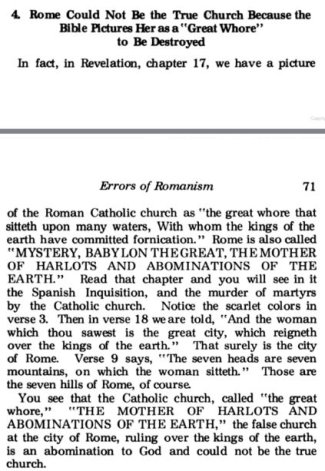
are wary of the "Reformed" crowd (they murdered Servetus after all) insisting they were never "Protestant" and never had anything to do with the "Great Whore" (Catholic Church)
Ahem...Never heard the Catholics described as "the great whore" by an independent Baptist
John R. Rice, in his chapter on "Errors of Romanism", in False Doctrines (1970)