• Welcome to Baptist Board, a friendly forum to discuss the Baptist Faith in a friendly surrounding.

    Your voice is missing! You will need to register to get access to all the features that our community has to offer.

    We hope to see you as a part of our community soon and God Bless!

Without Christ's Substitutionary Death, There Could Be No Gospel

Status
Not open for further replies.

JonC

Moderator
Moderator
As I wrote, I am quite happy to let others judge the meaning of Isaiah 53. It is very straightforward. Adding this or that verse to the extract that I quoted in post #19 does not change the meaning of the extract.

If you are going to pose as some sort of guru who has mastered the mystery of the cross, you need to do a lot better than this. The verb 'to bear' has a number of different meanings in English, but the Holy Spirit, who authored the New Testament, was careful to distinguish between those meanings.
1 Peter 2:24. 'Who Himself bore our sins in His own body on the tree, that we, having died to sins, might live for righeousness. By His wounds, we are healed.' The Greek word here is anaphero. It appears in the N.T. only twice; the other instance is Hebrews 9:28. '...So Christ was offered once to bear the sins of many.'
If Christ bore our sins, not in some metaphorical sense, but in His own body, and if we are still in our sins, it would appear that He died for nothing. Moreover, He bore them 'on the tree' (Gk. xulon, not stauron, 'cross'). He bore the curse attached to our sins (Gal. 3:13). If we are still cursed by God, Christ has failed abysmally. But He bore our sins and the curse instead of us. That is the meaning the verse requires.

Now when we come to Galatians 6:2, the word for 'bear' is bastazo. 'Bear one another's burdens, and so fulfil the law of Christ.' There is an entirely different meaning. I cannot bear someone else's 'sorrows' (your word) in my own body on a tree, and nor can I bear them so that the someone else does not bear them any more. The best I can do is share them and sympathize, weeping with those who weep; and that is doubtless what I should do.

I agree with this. It seems to me that you keep talking the talk, but you fail to walk the walk. Your presuppositions have blinkered you to the extent that you cannot see the plain meaning of God's words.

I don't have a 'theory.' I believe and teach the Doctrine of Penal Substitution, which is clearly found in the Bible, and, less importantly, but nonetheless factually, was taught by many of the Church Fathers, Reformers and Puritans.

Words are cheap, but God's word is indeed true, and I tell you that if Christ did not pay the penalty for your sin and mine in full upon the cross, we will have to pay it in full ourselves. Praise God, He did indeed pay it, and for that He deserves the highest worship and praise. Instead, you are slighting His work, and thereby slighting Him.
Lol... it does not take a language expert to determine that bearing another's sins or anothers sorrows is not stating bearing "instead of" the other person. It just takes literacy.

The major problem is your inconsistenty. You do not say that us bearing God's image is instead of God bearing His image You do not say that us bearing one another's sorrows takes the sorrow from the one grieving. You do not say us bearing Jesus' righteousness means Jesus is no longer righteous.

You only apply the "that is clearly what the language means" argument with Jesus bearing our sins.

You make the addition in that one instance because your theory demands it.


But you completely ignore what God said testifies to Christ's work (you ignore the Day of Atonement because it contains no substitution or death in the remission of sins).

What you do, however, is more problematic. You change "making atonement" from cleansing to penal substitution and then change the method to be killing an animal.

But yes. Let the people who read this thread compare what is claimed to Leviticus 16.

The priest makes atonement for the tent, the alter, and then the sins of the people. Making atonement is not the sacrifice of an animal (the sacrifice for atonement) in the Hebrew faith. It is in paganism, but not in the Bible.

After the priest has made atonement for the sins of the people they are cleansed from the defilement of sin.

But then the priest addresses sins themselves. The sins are symbolically placed on a goat. The goat bears the people's sins and carries them away. The goat is not the animal killed.

There is absolutely no substitution in the Levitical system except in the context the unharmed goat could represent sins.
 

JonC

Moderator
Moderator
It is pretty simple. Scripture interprets Scripture.

"It pleased God (it was God's will or plan) to crush Him"

1. That could mean that it was God's will for God Himself to crush (or strike) Him.

2. That could mean that to crush (or strike) Him was God's predetermined plan.

So how do we know which is correct? Do we go to theories or to Scripture? I pick Scripture because I believe Scripture interprets Scripture.

In Genesis we read thar God told Satan he would "crush" (or strike) Him.

In Acts we read that He died under wicked powers but this was God's predetermined plan.

In Isaiah 53 we read that Jesus was killed by an unjust authority or power (oppression). Acts references Isaiah 53 to declare Christ's death was an unjust judgmemt.


I understand some will go for #1 - that God Himself unjustly killed Jesus. @Martin Marprelate even admitted he believes God oppressed Jesus.

But if Scripture interprets Scripture then the second option is correct.
 

Martin Marprelate

Well-Known Member
Site Supporter
Lol... it does not take a language expert to determine that bearing another's sins or anothers sorrows is not stating bearing "instead of" the other person. It just takes literacy.
It is just as well if it doesn't take a language expert to determine these things, because you sure aren't one. I have pointed out that to bear someone's sins and to bear his sorrows require two different verbs in the Greek precisely because they are two different things
The major problem is your inconsistenty. You do not say that us bearing God's image is instead of God bearing His image
Not at all. Inconsistency is your problem, not mine. The Greek verb used in 1 Cor. 15:49 is phoreo, which is different again from the verbs used in 1 Peter 2:24 and Gal. 6:2. The Holy Spirit makes a difference between these verses. Who are you to conflate them?
You do not say that us bearing one another's sorrows takes the sorrow from the one grieving. You do not say us bearing Jesus' righteousness means Jesus is no longer righteous.

You only apply the "that is clearly what the language means" argument with Jesus bearing our sins.
Indeed. Christ bearing our sins in His own body on the tree is what I'm discussing. We are discussing Penal Substitution. If you wasnt to discuss imputed righteousness, I'm up for that Open a new thread. But while we're at it, do you believe that our Lord bearing our curse means that we are still cursed? Yes or no.
You make the addition in that one instance because your theory demands it.
No. I do it because the word of God demands it, as I have explained.
But you completely ignore what God said testifies to Christ's work (you ignore the Day of Atonement because it contains no substitution or death in the remission of sins).

What you do, however, is more problematic. You change "making atonement" from cleansing to penal substitution and then change the method to be killing an animal.

But yes. Let the people who read this thread compare what is claimed to Leviticus 16.

The priest makes atonement for the tent, the alter, and then the sins of the people. Making atonement is not the sacrifice of an animal (the sacrifice for atonement) in the Hebrew faith. It is in paganism, but not in the Bible.
I think it may be worth quoting several verses from Hebrews 10:8ff. 'Previously saying, "Sacrifice and offering, burnt offerings, and offerings for sin [all the Levitical sacrifices] You did not desire, nor had pleasure in them" (which are offered according to the law), then He said, Behold, I have come to do Your will, O God." He takes away the first that He may establish the second. By that will [of God] we have been santified through the offering of the body of Jesus Christ once for all. And every priest stands ministering daily and offering repeatedly the same sacrifices, which can never take away sins, but this Man, after He had offered one sacrifice for sins forever, sat down at the right hand of God.... For by one offering He has perfected forever those who are being sanctified.'
The Levitical sacrifices and offerings could never take away sins. Only Christ in His one perfect sacrifice of Himself could do that. But on the Day of Passover (Exodus 12), where were the tent and the altar and the furnishings that you go on about? They did not yet exist. The Israelites trusted in the Passover Lamb to take away our sins, looking forward to the true Passover (1 Cor. 5:7).
After the priest has made atonement for the sins of the people they are cleansed from the defilement of sin.

But then the priest addresses sins themselves. The sins are symbolically placed on a goat. The goat bears the people's sins and carries them away. The goat is not the animal killed.

There is absolutely no substitution in the Levitical system except in the context the unharmed goat could represent sins.
Whom do the two goats prefigure (c.f. John 5:39)? Christ (1 Cor. 5:7) and Christ (John 1:29) in that order. Christ the propitiation for our sins satisfying the justice of God, and Christ taking away our sins forever.
If you want to start another thread on Lev. 16, or all the Levitical sacrifices, I'm up for that.
 

Anthony Pritchard

Well-Known Member
"Sin debt" is not an "alternate theory". It is solid Biblical teaching. Even we humans use the term for those who break law administered by man. Have you ever heard of paying one's debt to society in describing enduring the punishment for breaking law administered by man?

Furthermore,

Mark 10:45 For even the Son of man came not to be ministered unto, but to minister, and to give his life a ransom for many.

A ransom is a payment.

Furthermore,

Isaiah 53:4-6 Surely he hath borne our griefs, and carried our sorrows: yet we did esteem him stricken, smitten of God, and afflicted. But he was wounded for our transgressions, he was bruised for our iniquities: the chastisement of our peace was upon him; and with his stripes we are healed. All we like sheep have gone astray; we have turned every one to his own way; and the LORD hath laid on him the iniquity of us all.

Furthermore,

From Isaiah 53:8 For the transgression of my people was he stricken.

Furthermore,

From Isaiah 53:10 Yet it pleased the LORD to bruise him; he hath put him to grief: when thou shalt make his soul an offering for sin.

Furthermore,

From Isaiah 53:11 He shall bear their iniquities.

Furthermore,

From Isaiah 53:12 He bare the sin of many.

Furthermore,

1 Peter 1:18-19 Forasmuch as ye know that ye were not redeemed with corruptible things, as silver and gold, from your vain conversation received by tradition from your fathers; but with the precious blood of Christ, as of a lamb without blemish and without spot.

To redeem something is to buy it back.

I have now shown that the Bible teaches that it was God the Father who placed the punishment for the sin debt of His elect upon God the Son to redeem them, or buy them back, from the justice that they were deserving of, and God's justice being satisfied in God the Son's perfect life lived and willing sacrifice offered in the stead of God's elect.

God the Son had the power to do ALL of this.
God the Son was willing to do ALL of this.
God the Son accomplished ALL of this.

God does not just overlook sin, He does not just wave His hand and clear the guilty(Exodus 34:7). The sins of God's elect and their guilt was imputed to Christ, He satisfied God's justice, and His perfect righteousness was imputed to God's elect.

2 Corinthians 5:21 For he hath made him to be sin for us, who knew no sin; that we might be made the righteousness of God in him.

(emphasis mine)


How dare you call me a "kid". I am nearly 71 years old.
I'll be 71 Sept 3, we're both old timers. Bringing the rhetorical hammer, furthermore, 1784763411148.png
 

JonC

Moderator
Moderator
It is just as well if it doesn't take a language expert to determine these things, because you sure aren't one. I have pointed out that to bear someone's sins and to bear his sorrows require two different verbs in the Greek precisely because they are two different things

Not at all. Inconsistency is your problem, not mine. The Greek verb used in 1 Cor. 15:49 is phoreo, which is different again from the verbs used in 1 Peter 2:24 and Gal. 6:2. The Holy Spirit makes a difference between these verses. Who are you to conflate them?

Indeed. Christ bearing our sins in His own body on the tree is what I'm discussing. We are discussing Penal Substitution. If you wasnt to discuss imputed righteousness, I'm up for that Open a new thread. But while we're at it, do you believe that our Lord bearing our curse means that we are still cursed? Yes or no.

No. I do it because the word of God demands it, as I have explained.

I think it may be worth quoting several verses from Hebrews 10:8ff. 'Previously saying, "Sacrifice and offering, burnt offerings, and offerings for sin [all the Levitical sacrifices] You did not desire, nor had pleasure in them" (which are offered according to the law), then He said, Behold, I have come to do Your will, O God." He takes away the first that He may establish the second. By that will [of God] we have been santified through the offering of the body of Jesus Christ once for all. And every priest stands ministering daily and offering repeatedly the same sacrifices, which can never take away sins, but this Man, after He had offered one sacrifice for sins forever, sat down at the right hand of God.... For by one offering He has perfected forever those who are being sanctified.'
The Levitical sacrifices and offerings could never take away sins. Only Christ in His one perfect sacrifice of Himself could do that. But on the Day of Passover (Exodus 12), where were the tent and the altar and the furnishings that you go on about? They did not yet exist. The Israelites trusted in the Passover Lamb to take away our sins, looking forward to the true Passover (1 Cor. 5:7).

Whom do the two goats prefigure (c.f. John 5:39)? Christ (1 Cor. 5:7) and Christ (John 1:29) in that order. Christ the propitiation for our sins satisfying the justice of God, and Christ taking away our sins forever.
If you want to start another thread on Lev. 16, or all the Levitical sacrifices, I'm up for that.
My point is neither case is substitution (the language itself).

Bearing our sins could be a substitution but the language does not demand it.

I used Scripture to define "Christ bearing our sins" as non-substitutinal (sharing our humanity, coming in the likeness od sinful flesh, the OT sacrifices, etc).

Thus far your claim is that its substitution because you want it to be substitution. That does not work.

Look where your theory has taken you. You stated that "God oppressed Jesus". I have to respect your willingness to state what you believe even though it is a heresy (calling God an oppressor). But I cannot respect the heresy itself because I firmly believe God's judgment is never oppression (it is always just).
 

JonC

Moderator
Moderator
I'll be 71 Sept 3, we're both old timers. Bringing the rhetorical hammer, furthermore, View attachment 14328
September is a good month (my birthday is Sep 16... but I won't be 71).

The issue I have with the post you quoted is none of the passages in the post actually support the member's conclusion.

We all believe those passages are true. It is that which is brought into the text that causes divisions.

Isaiah calls Jesus' suffering and death "oppression" (the unjust exercise of power or authority). Luke quotes Isaiah, but instead of "oppression" he uses "unjust judgment".

The conclusion I was given was that "God oppressed Jesus", that God exercized unjust power and authority but this was necessary to pay a "sin debt".

We have to allow the biblical text dictate what we believe.

All this started because I quoted several passages that apparently I was supposed to ignore. I do not believe that is right.

1. We know that God will not clear the guilty.
2. We know that God will not punish the Righteous.
3. We know that "making atonement" is not forgiveness but cleansing from unrighteousness and the stain of sin.
4. We know that forgiveness was linked to sins being carried away rather than redeemed.

We know that because that is what the biblical text states.

I do not understand how one can hold opposing ideas and ignore the contradiction by saying "it is just a mystery... we do not know how God remains just yet is unjust in His judgment, but we know that is true".


Saying God exercized His unjust authority in punishing the Righteous in order to clear the guilty is something I can never support.
 

KenH

Well-Known Member
1 Peter 3:18 For Christ also hath once suffered for sins, the just for the unjust, that he might bring us to God, being put to death in the flesh, but quickened by the Spirit.

Romans 4:5 But to him that worketh not, but believeth on him that justifieth the ungodly, his faith is counted for righteousness.

Clearly, "the just for the unjust" is the language of substitution.

(emphasis mine)
 

KenH

Well-Known Member
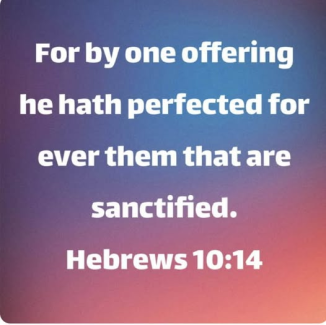
For by one offering He has perfected forever those who are being sanctified.
I have the below pinned to the top of my timeline on my Facebook page:


“Fold up, my soul, this blessed verse, in thy bosom, and carry it about with thee in thine heart. Let it be among the first and last of thy thoughts, when thou liest down, and when thou risest up.” - Robert Hawker

1784812654939.png
 

JonC

Moderator
Moderator
1 Peter 3:18 For Christ also hath once suffered for sins, the just for the unjust, that he might bring us to God, being put to death in the flesh, but quickened by the Spirit.

Romans 4:5 But to him that worketh not, but believeth on him that justifieth the ungodly, his faith is counted for righteousness.

Clearly, "the just for the unjust" is the language of substitution.

(emphasis mine)
No, the Just for the unjust is not "clearly" the language of substitution. It could instead be the language of redemption (I believe it is the language of redemption).

The "clearly" is a logical fallacy, BTW. It is a dogmatic assertion. There are several other possibilities. You see substitution. I see redemption. Others have seen correction.

We have to go to the biblical text to see which is correct, not just assume it is substitution or redemption, or correction.
 

KenH

Well-Known Member
ut in fact He took away our sins by paying the penalty for them.

Amen!

'He was wounded for our transgressions.' The transgressions were ours; the wounds were His. Penal substitution! He was wounded for our iniquities.' The iniquities were ours; the wounds were His. Penal substitution! 'The chastisement for our peace was upon Him.' The peace is ours; The chastisement was upon Him. Penal Substitution!

Amen!

the Triune God decreed it

Amen!

From Acts 2:23 Him, being delivered by the determinate counsel and foreknowledge of God.

From Revelation 13:8 The Lamb slain from the foundation of the world.
 

rsr

<b> 7,000 posts club</b>
Moderator
We were one day conversing with an unbeliever who lay on a bed of suffering and was murmuring against the God that made him. He put the question in an angry tone,
“Where did this pain come from?”
“From sin,” we answered.
“But why should pain follow sin?”
“Because God is a righteous God.”
“How does that prove that where there is pain there must have been sin?”
“Because a righteous God must punish what is wrong.”
“Why must He?’
“Because if He did not the universe would go to pieces.”
“How so?”
“Just as a kingdom would go to wreck if the ruler did not punish evil doers, so the whole universe would go into disorder if God did not attach punishment to sin.”
The sufferer thought a little, and then admitted that this was right, and that pain ought to be the consequent of sin, for the sake of preserving the universe in order and happiness.
Again he asked,
“What do you mean by sacrifice, and why was it necessary?”
“Because sin must be punished.”
“What has that to do with sacrifice?
“Much every way; chiefly this, that sacrifice is punishment—the punishment of one instead of another—for it is impossible that there can be sin without punishment.”
“But is that just?”
“Quite just, if he who is to bear the punishment undertakes it of his own free will, and is not compelled.”
“How so?”
“In this way: If you were in debt and I were compelled to pay your debts, there would be great injustice; but if I came forward and did it willingly, there would be no injustice to any one, and the law would be maintained.”
He thought a little, and then said calmly and distinctly,
“Yes, I see that; there would be no injustice then.”
“Just so is it,” we said, “with the payment of our debts by the Son of God. He came forward and presented His sufferings to God instead of ours, His life instead of ours, His death instead of ours.”
The sufferer was greatly interested, and the light seemed to break into his dark soul, as we then spoke to him of Christ “bearing our sins in His own body on the tree,” “suffering, the just for the unjust, that He might bring us to God.”
It is on this great truth of substitution that the Gospel rests, for without this work of sin-bearing by the Son of God there could be no Gospel to the sinner. The proclamation of God’s love without the expiation on the Cross would be mockery. It would bring no satisfaction, no relief, no peace. Sin must be borne and its penalty exhausted before the guilty can draw nigh to God. And thus a German poet sings:—

“I and my heavy load of guilt,
My sins of crimson dye,
As countless as the grains of sand
That on the sea-shore lie—
These brought on Thee, dear suffering Lord,
The woes which were on Thee out-poured.

“I, I it is, who should atone
Bound hand and foot in hell;
I, I it is should bear the bonds,
The scourge which on Thee fell:
Yea, all that was endured by Thee
Hath been deserved, dear Lord, by me.”

- Excerpt from Horatius Bonar's Bruised For Our Iniquities
Locked at OP's request.
 
Status
Not open for further replies.
Top