

typical of wiki although oft times i don't take the time to do scholarly fact checking with them.This is relevant, but not exactly parallel to the modern concept of an oral translation.
A couple of years ago I was sent to an African country to see if we could get an oral translation started for a people group with an unwritten language in that country. I spent time training the prospective African translators, then we spent time working on 1 John, getting partway. (One of the men went ahead and finished that book on his own.) We took digital recorders with us with the idea of putting our work onto those. Unfortunately, the nationals did not take up the complete burden, and the work stalled. However, the idea was that the final product would exist only digitally, not on paper, so that it could be shared on digital machines of various kinds.
Thanks for the link. The article is typical Wikipedia, with the general facts right, but some errors, at least in the discussion of Japanese. For example, there are five syllables in the Japanese alphabet which are strictly vowels, so the syllabary is not just "mainly CV," as the article says. Looks like someone knew what they were doing, then someone corrected it who didn't.
my presumption is that a syllabary must start off with some kind of alphabet - e.g. English?
when the oral "codification" is finally put to paper or electronic device - transliterated as the Cherokee syllabary.
BTW - The Cherokee Nation was granted the status as one of the Five Civilized Indian Nations.
And i think it appropriate - I had a friend of Cherokee descent at Calvary University who was one of the most civilized people I had ever met (although he had a temper - hard to ignite but volatile).
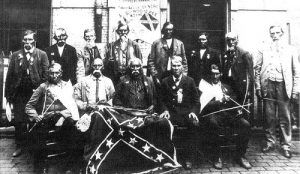
Cherokee Civil War Veterans in 1903
Five Civilized Tribes – Legends of America
As it turns out we were not exactly models of civility to them.
Last edited:


