
• Welcome to Baptist Board, a friendly forum to discuss the Baptist Faith in a friendly surrounding.

    Your voice is missing! You will need to register to get access to all the features that our community has to offer.

    We hope to see you as a part of our community soon and God Bless!

Oral Bible Translations

HankD

Well-Known Member
Site Supporter
This is relevant, but not exactly parallel to the modern concept of an oral translation.

A couple of years ago I was sent to an African country to see if we could get an oral translation started for a people group with an unwritten language in that country. I spent time training the prospective African translators, then we spent time working on 1 John, getting partway. (One of the men went ahead and finished that book on his own.) We took digital recorders with us with the idea of putting our work onto those. Unfortunately, the nationals did not take up the complete burden, and the work stalled. However, the idea was that the final product would exist only digitally, not on paper, so that it could be shared on digital machines of various kinds.


Thanks for the link. The article is typical Wikipedia, with the general facts right, but some errors, at least in the discussion of Japanese. For example, there are five syllables in the Japanese alphabet which are strictly vowels, so the syllabary is not just "mainly CV," as the article says. Looks like someone knew what they were doing, then someone corrected it who didn't. :Biggrin
typical of wiki although oft times i don't take the time to do scholarly fact checking with them.

my presumption is that a syllabary must start off with some kind of alphabet - e.g. English?
when the oral "codification" is finally put to paper or electronic device - transliterated as the Cherokee syllabary.

BTW - The Cherokee Nation was granted the status as one of the Five Civilized Indian Nations.
And i think it appropriate - I had a friend of Cherokee descent at Calvary University who was one of the most civilized people I had ever met (although he had a temper - hard to ignite but volatile).
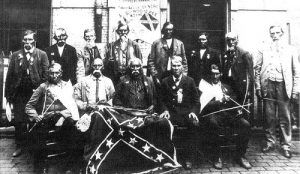
CherokeesCivilWar-300x174.jpg

Cherokee Civil War Veterans in 1903

Five Civilized Tribes – Legends of America

As it turns out we were not exactly models of civility to them.
 
Last edited:

John of Japan

Well-Known Member
Site Supporter
typical of wiki although oft times i don't take the time to do scholarly fact checking with them.

my presumption is that a syllabary must start off with some kind of alphabet - e.g. English?
when the oral "codification" is finally put to paper or electronic device - transliterated as the Cherokee syllabary.
"Syllabary" is actually a linguistic term for an alphabet based completely on syllables. Japanese is one of those, with 46 characters, each representing a syllable. Several of those can be combined with others for sounds without their own complete syllable, and there is just one sound that represents a single consonant, but they think of it as a syllable (ん).

BTW - The Cherokee Nation was granted the status as one of the Five Civilized Indian Nations.
And i think it appropriate - I had a friend of Cherokee descent at Calvary University who was one of the most civilized people I had ever met (although he had a temper - hard to ignite but volatile).

CherokeesCivilWar-300x174.jpg

Cherokee Civil War Veterans in 1903

Five Civilized Tribes – Legends of America

As it turns out we were not exactly models of civility to them.
The "Trail of Tears" is one of the most shameful events of US history.
 
Last edited:

HankD

Well-Known Member
Site Supporter
"Syllabary" is actually a linguistic term for an alphabet based completely on syllables. Japanese is one of those, with 46 characters, each representing a syllable. Several of those can be combined with others for sounds without their own complete syllable, and there is just one sound that represents a single consonant, but they think of it as a syllable (ん).
an AMAZING and fascinating part of God's promise to preserve His word for the human race into ETERNITY.

1 Peter 1:25 But the word of the Lord endureth for ever. And this is the word which by the gospel is preached unto you.

The "Trail of Tears" is one of the most shameful events of US history.
Yes nations like people have sins.
We have true sorrow LORD for this sinful darkness in our history committed against our Native Americans.

I am wondering - do you believe there a benefit to a syllabary over an alphabet in the development of the migration from an Oral Tradition to a written word of God?
 

John of Japan

Well-Known Member
Site Supporter
an AMAZING and fascinating part of God's promise to preserve His word for the human race into ETERNITY.

1 Peter 1:25 But the word of the Lord endureth for ever. And this is the word which by the gospel is preached unto you.


Yes nations like people have sins.
We have true sorrow LORD for this sinful darkness in our history committed against our Native Americans.

I am wondering - do you believe there a benefit to a syllabary over an alphabet in the development of the migration from an Oral Tradition to a written word of God?
I'd have to say it depends on the language. Most languages, especially Indo-European languages, are not helped by a syllabary. English would be much more difficult with a syllabary, since it was developed from several other languages and thus has a lot more phonemes (minimum unit of sound) that most languages.

Japanese is limited in its phoneme combinations (syllables) compared to English (which has a much greater number of vowels) so the 46 character syllabary works quite well (with a number of compounds also). By the way, this is why Japanese have such difficulty with the English "L" and "R," since the only Japanese phoneme that is similar is actually between these two sounds.
 
Last edited:

HankD

Well-Known Member
Site Supporter
I'd have to say it depends on the language. Most languages, especially Indo-European languages, are not helped by a syllabary. English would be much more difficult with a syllabary, since it was developed from several other languages and thus has a lot more phonemes (minimum unit of sound) that most languages.

Japanese is limited in its phoneme combinations (syllables) compared to English (which has a much greater number of vowels) so the 46 character syllabary works quite well (with a number of compounds also). By the way, this is why Japanese have such difficulty with the English "L" and "R," since the only Japanese phoneme that is similar is actually between these two sounds.
Interesting - seems less difficult to me then to skip the syllabary phase and go directly to an alphabetic written word for word system.

thinking about this i see English words themselves as almost being compound syllabary elements.

No longer do i sound out each word as did in my childhood but recognize each word based upon the collective form of its English letters.
 

John of Japan

Well-Known Member
Site Supporter
Interesting - seems less difficult to me then to skip the syllabary phase and go directly to an alphabetic written word for word system.

thinking about this i see English words themselves as almost being compound syllabary elements.

No longer do i sound out each word as did in my childhood but recognize each word based upon the collective form of its English letters.
By George, I think we're making a linguist out of you! :Cool
 

agedman

Well-Known Member
Site Supporter
Thank you for the very interesting link. However, this is not exactly what a modern oral Bible translation is about. It is one thing for a genius like Sequoyah to invent an alphabet for his own people, but it is another thing to produce a translation of the Bible that does not exist in written form.
I agree. I forget who took Sequoyah’s work and did a translation.

I grabbed the from Wiki..
In 1824 the first portion of the Bible was translated into the Cherokee language: John 3, translated by a native Cherokee, ᎠᎢ (At-see, also known as John Arch). It was circulated in manuscript, and received with wonderful avidity, being copied hundreds of times.[1] He completed the Gospel of John by 1824[2] The complete New Testament was translated in September 1825 by David Brown, also a native Cherokee; this was also circulated in manuscript form, as a type for the Cherokee syllabary had not yet been created. Both Archer and Brown translated the full New Testament into Cherokee.[3]
I don’t know the source (manuscripts or KJV).

But, what (to me) is neat is tracing the impact Sequoia’s original work had on the people.

I would think it actually would have been effective in “standardizing” the dialects such as I was taught the KJV did in spelling, grammar, punctuation... in English.
 

John of Japan

Well-Known Member
Site Supporter
I agree. I forget who took Sequoyah’s work and did a translation.

I grabbed the from Wiki..
In 1824 the first portion of the Bible was translated into the Cherokee language: John 3, translated by a native Cherokee, ᎠᎢ (At-see, also known as John Arch). It was circulated in manuscript, and received with wonderful avidity, being copied hundreds of times.[1] He completed the Gospel of John by 1824[2] The complete New Testament was translated in September 1825 by David Brown, also a native Cherokee; this was also circulated in manuscript form, as a type for the Cherokee syllabary had not yet been created. Both Archer and Brown translated the full New Testament into Cherokee.[3]
I don’t know the source (manuscripts or KJV).

But, what (to me) is neat is tracing the impact Sequoia’s original work had on the people.
That is extremely neat. I like the fact that Brown's NT was circulated in manuscript form, showing how precious it was to the Cherokee believers. However, this is not the same as the "oral translation" approach of the OP.

I would think it actually would have been effective in “standardizing” the dialects such as I was taught the KJV did in spelling, grammar, punctuation... in English.
This is exactly what the invention of a writing system (alphabet or syllabary) does. Quite often a translation effort for a people group with an unwritten language begins with the translator recording the oral traditions of the people. This goes hand in hand with the phonological and morphological survey of the language with the goal of producing a writing system. Eventually, when the missionary knows the language well enough and God has led a tribal person or several to help, the written translation work will begin.

A strictly oral approach, on the other hand, is touted as shortening the process. The argument is that "A recorded oral Bible will help serve as a standard to ensure that the transmission of the [Bible] stories remains accurate" ("Making Disciples of Oral Learners," in Perspectives on the World Christian Movement, ed. by Ralph D Winter and Steven C. Hawthorne, p. 439).
 
Last edited:

John of Japan

Well-Known Member
Site Supporter
Here is an awesome little film of a tribe in Papua receiving their written New Testaments for the very first time:
 

John of Japan

Well-Known Member
Site Supporter
What it isn't. It's not the greatest thing since sliced bread and homogenized peanut butter.
Wait...they do that to peanut butter?? :eek:

Yeah, I have mixed feelings about this subject, so I'm trying to talk it through here with my BB friends. On the one hand, an oral translation is better than none at all. But on the other hand, I don't know how you do an oral translation without writing things down, or better, typing them into the computer. So if it is already written down, why make it oral?
 

John of Japan

Well-Known Member
Site Supporter
It would be oral for the recipients of the translation. Why would it need to be strickly oral for the translators working from the Hebrew and Greek texts?
Precisely.

So in the long run, to me an oral translation would be a stopgap measure, not something permanent. After completing an oral version, the translators should go ahead and make it written.
 

HankD

Well-Known Member
Site Supporter
Wait...they do that to peanut butter?? :eek:

Yeah, I have mixed feelings about this subject, so I'm trying to talk it through here with my BB friends. On the one hand, an oral translation is better than none at all. But on the other hand, I don't know how you do an oral translation without writing things down, or better, typing them into the computer. So if it is already written down, why make it oral?
Didn't the Waldensian do this in a way? They memorized whole books and sections of the bible to evangelize parts of Europe.
They did this so as to not get arrested by the RCC for possessing the written word?
 

John of Japan

Well-Known Member
Site Supporter
Didn't the Waldensian do this in a way? They memorized whole books and sections of the bible to evangelize parts of Europe.
They did this so as to not get arrested by the RCC for possessing the written word?
That would be quite similar, but the reason for doing so would be different, and the process different (translating as opposed to memorizing an existing Bible).
 

HankD

Well-Known Member
Site Supporter
That would be quite similar, but the reason for doing so would be different, and the process different (translating as opposed to memorizing an existing Bible).
I remember reading that the Waldensian pastors preferred a French version (Olivetan?) of the Traditional Text type.
 

John of Japan

Well-Known Member
Site Supporter
Thank you everyone who has participated in this thread. I'll share with you some of the lecture notes I've been developing as we discussed the subject. (Please do not disseminate this copyrighted material without permission.)

Here are the positives

II. Advantages of the Oral Approach
  1. Producing an oral translation rather than a written one has a number of advantages.
    1. This approach utilizes the story-telling and tradition transmission of cultures with no written language. It is thus thought of as successful contextualization.
    2. A literacy program is not needed with this approach.
    3. An oral translation supposedly does not take as long as a written translation.
    4. It can reach both literate and non-literate people in the target people group.
  2. The translation could be propagated through cell phones.
    1. “The number of mobile phone users in the world is expected to pass the five billion mark by 2019. In 2016, an estimated 62.9 percent of the population worldwide already owned a mobile phone. The mobile phone penetration is forecasted to continue to grow, rounding up to 67 percent by 2019.”[1]
    2. When there are no cell phones among a people group, a dedicated voice recorder could be used. These can be purchased at $25-$30 retail, but at a bulk or wholesale rate could cost much less.
    3. The cost of cell phones or recorders is still significantly greater than the cost of producing a written New Testament. Also, there must be an electric source for this approach to work.
  3. The process of translating the Bible for a people group with an unwritten language is long and involved. A strictly oral approach, on the other hand, is touted as shortening the process. The argument is that “A recorded oral Bible will help serve as a standard to ensure that the transmission of the [Bible] stories remains accurate.”[2]
  4. To be fair, here is an example of an oral translation which appears to be accomplishing its goals, and the technology used for it: “THE SHUAR PROCLAIMER PROJECT: The Proclaimers have arrived!!! There are 600 SHUAR villages spread throughout the jungle, most have never heard God’s Word. Our goal is to deliver an audio New Testament (in Shuar) to each village through a little solar powered box called a Proclaimer. It was recorded and produced by ‘Faith Comes By Hearing’ out of Albuquerque. Village by village, the miracle is unfolding!”[3]

[1] Statista, at Number of mobile phone users worldwide 2015-2020 | Statista. Accessed on 8/12/19.

[2] International Orality Network, “Making Disciples of Oral Learners,” in Perspectives on the World Christian Movement, 4th ed., ed. by Ralph D Winter and Steven C. Hawthorne (Pasadena: William Carey Library, 1981, 1982, 1999, 2009), 439.

[3] “Matt and Ashley Richardson,” on the website of the Alabama Assemblies of God, accessed on 8/20/19 at: Matt and Ashley Richardson | Missionaries | Alabama District Council of the Assemblies of God.
 

John of Japan

Well-Known Member
Site Supporter
Here are the negatives of the method:

III. Significant Problems with the Oral Approach
  1. The oral approach depends on technology, which is ever changing. An oral translation done with an analog recording machine would be difficult to reproduce now.
  2. There are limitations to recording technology.
  1. The memory of the device may not be sufficient for the whole Bible.
  2. A cell phone or recording device may become obsolete and unusable.
  3. A cell phone or recorder is often easier to destroy than a written book.
  1. The cost of propagating an oral translation is significantly greater than the cost of printing a written translation.
  2. In the typical traditional translation effort, there are souls saved and churches established even during the translation process. So Bible translation itself is a means of producing Bible Christianity among a people group.
  3. The literacy movement necessary in a traditional approach (which produces a written Scripture) results in an overall improvement in the lives of the people group, and an elevation in their lifestyle in many ways: medical improvements, education, communication with their government, etc. It does take longer than an oral approach, but is more profitable to the people group in the long run.
  4. In some cases, oral transmission may degrade the content of the record.[1] An example of this is the “Hidden Christians” of Japan, who went underground during the severe persecutions of the Tokugawa Shogunate in the 17th century. Francis Xavier had not seen fit to produce a Bible translation, so the people had nothing to judge their doctrine by except the traditions and a few copied, non-Scriptural documents. By the time Catholic missionaries were allowed in again in the mid-19th century, the beliefs of the Hidden Christians were unrecognizable.
One thing was clear: the Hidden Christians were neither as hidden nor as Christian as their name suggests. The faith had undergone many changes during the long years of persecution, as a result of which it had diverged so far from the original that it was often unrecognizable.[2]
  1. Having a physical book in one’s hands has a very long history, including Bible times, when books were available in codex form.
1. A physical book may be consulted any time without batteries.
2. One may underline or highlight verses, and write notes in a physical Bible.
3. Distribution of a physical Bible is simple.
4. One can read a physical Bible without disturbing others. Earbuds or headphones must be supplied for an oral book to accomplish this.
  1. We may rightly ask if the oral method truly does shorten the process. Is it the ideal way to produce the Bible in an unwritten language? Or is it simply a stopgap measure to be used until an actual printed book is produced?

[1] P. Himes asserts that there is recent research contradicting this, and points out that the Torah was no doubt transmitted orally from parents to children (Deut. 6:6-9). Also, a certain level of syncretism was present among the Hidden Christians, which would have degraded the message.

[2] John Dougill, In Search of Japan’s Hidden Christians (Tokyo: Tuttle, 2012), 223.
 
Top