• Welcome to Baptist Board, a friendly forum to discuss the Baptist Faith in a friendly surrounding.

    Your voice is missing! You will need to register to get access to all the features that our community has to offer.

    We hope to see you as a part of our community soon and God Bless!

Is the KJV's rendering the most accurate in these ten passages?

Alan Dale Gross

Well-Known Member
After showing their dependence upon their deception of unceremoniously placing all Bible readers who prefer the Supernaturally Inspired Superiority of the King James Bible**, into the "King James Only Camp" of Peter Ruckman's heresies, and presumably dismissing them all, "Like shooting fish in a barrel", they next proceed to embarrass themselves by bragging on their ignorance, if not just being illiterate, of the English Language and others, also.

**(remind me to illustrate this to you).
Do you try an inexcusable, irresponsible hack job as you throw out misleading and incorrect accusations against believers
who disagree with human, non-scriptural KJV-only reasoning/teaching?
So, what do you consider KJV-only reasoning/teaching?
Who is it you call KJV-Only?
Believers who disagree with KJV-only teaching do not treat the Bible like they would any other book. That misrepresentation may be a strawman.
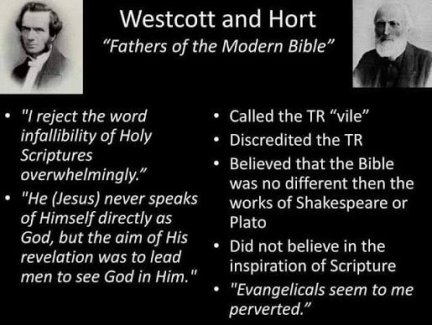
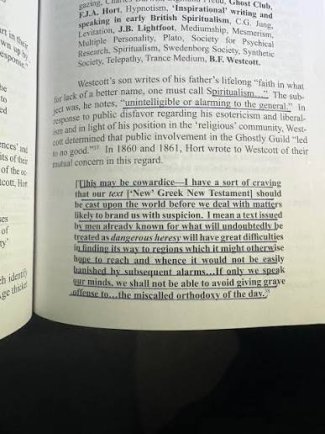
I'm not talking about the 'believers'. I mean that was the initial consensus with the Spiritualists and directive given by the Luciferins to Westcott and Hort who then treated the Bible like they would any other book, right? And you know it was not God Who Led them to secretly change the Greek and pretend to make the lie of a fake 'revised' version of the KJV. Just thought you might want to keep it real.
WESTCOTT AND HORT.jpg
W H WROTE.jpg
Rejecting non-scriptural KJV-only claims is not a rejection of the preservation of the Scriptures.
Since 'reconstructing' the bible is a denial of the preservation of the Scriptures, this is just a lie, right.

Nothing unusual to have to lie, especially considering their disingenuous philosophy by which W&H undertook their own project of having their new Greek text slipped to the RSV Translators, without their knowledge, after they had intentionally tainted and sabotaged a rewriting of precious little underlying original language evidence, when those manuscripts resurfaced from the Underground Occult, after hundreds of years of abandonment, and which were highly suspect and questionable as to everything about their existence.

Garbage In = Garbage Out. So, lying is the order of the day.

What else are they going to do? Pretend to say something that's acceptable to God about them?

You'd think He would have been consulted more than how they obviously display His Conspicuous absence.

It is not claimed that everyone who uses the KJV is associated with Peter Ruckman.
This, of course, is as big a lie as the others.

No, I know, now you say Peter Ruckman isn't even a KJV-Only retard, because he didn't believe in the absolute exclusive use of the King James Bible by everyone, everywhere, but would acquiesce to the use of some Foreign Language versions by Foreigners.

I'm glad you read after KJV-Only nutcases. I don't. I don't have any use for them. I'm not looking for a simpleton emotional toddlerisk perspective on what they must be trying to say, which is that all the modern versions are supernatural evil influenced, in an Anti-Christ-type manner, causing them to lean hardest toward the occult in their wording of verses and those omitted, i.e., The New World Translation, than they ever do their supposed predecessor, the King James Bible.

Perhaps some KJV-only advocates attempt to mislead or deceive others concerning the accurate term KJV-only.
You and apparently all Modern Bible proponents who attempt to defend them and Westcott and Hort are advocates who attempt to mislead or deceive others concerning the accurate term KJV-only, by continually lying, and painting everyone who doesn't worship and purchase the modern products as KJV-Only nutcases.

Maybe you are not always lying and just have someone acting as an imposter who is just pretending to be you when you describe what you are saying a KJV-Only Bible reader fully prescribes to and believes about the KJV.
The accurate term KJV-only is used by Bible believers to define and describe any view that accepts or makes some type of exclusive claims for only one English Bible translation—the KJV.
Logos1560's KJV-Only means: any view that accepts or makes some type of exclusive claims for only one English Bible translation—the KJV.

Where, honestly, "some type of exclusive claim" means, "anyone who does not believe in 'Modern Bibles-Only' and purchase several modern version products every year or so". (At least that's your goal and those you work for.)

FORGET The KJV FOREVER FEVOR!

So, what if it has been God's Holy Bible the last 400 yrs+ and Saved and Spiritually Enriched Billions.

What a bunch of Sacrilegious and Blasphemous Apostates.
 
Last edited:

Alan Dale Gross

Well-Known Member
Holders of a KJV-only view would in effect attempt to suggest, assume, or claim that the KJV is the word of God translated into English in some different sense than any other English translation is the word of God translated into English.
"in effect attempt to suggest", (by any manner imaginable).
"assume", (anything imaginable)
"or claim" (or say they "claim" no matter what they actually "claim" and it doesn't matter who "claims" it)

"that the KJV is the word of God translated into English" (Yes, it is ONE THAT WE ARE SURE OF, AREN'T WE, WHICH IS ABOUT ALL ANYBODY EVER REALLY MEANS ABOUT IT, DEEP DOWN, PROBABLY, MEANING WELL AND MAKING TOO OVERSTATED CLAIMS, IN OPPOSITION TO THOSE WHICH ARE AT ENMITY AGAINST GOD IN HATRED OF HIS KING JAMES HOLY BIBLE.

WE KNOW THE KING JAMES BIBLE IS HIS, EVEN IF OTHERS ARE JUST AS COMPARIBLE, OR WHETHER THEY SUCK EGGS.

"in some different sense" (in any sense imaginable,
including praying to God for Guidance and an Unction from the Holy Spirit, for the Blood of Jesus to Inundate their work, and leave the King James Version Dripping with the Anointing Blood of Jesus Christ, WHICH IT DOES, EVEN IF NO OTHER VERSION DOES OR NOT, OR TRIES AS MUCH AS HUMANLY POSSIBLE TO NOT TO BE A TESTAMENT TO THE LORD JESUS CHRIST.

There are plenty of "English translations that are the word of God translated into English" in the line of Preservation and others more recent that were Faithfully Translated by the Process with Comparison of All Available Scriptures with Scriptures, but unless you can come up with a Testimony of a Personal Salvation Experience from the most predominant influences of the underlying Greek texts used by every other modern version, I'm opting out by keeping them at least ten miles from me and THERE IS NOTHING YOU CAN DO ABOUT IT, BUT FALSELY ACCUSE ME OF BELIEVING THE KJV IS SUPPOSED TO HAVE NEVER CHANGED FROM THE 1611, IN EVEN ONE WORD, AND SOME VERSION OF IT (?) WAS DOULBLE-INSPIRED AND PERFECT EXACTLY LIKE THE ORIGINAL AUTOGRAPHS FROM THE HAND OF THE BIBLE WRITERS AND GOD HIMSELF.

Because you've been taught and hired to lie, even though you already knew all about how to lie all on your own, before then.

Calling someone KJV-Only because they know we have and have had the Word of God in the King James Bible and many others before and since, just because they are aware and educated to the Dark Occult Origins in the History of the modern versions and view them the way the King James Bible Translators did their exclusive 1% of manuscript evidence as spurious, while discarding them out of hand, doesn't mean they believe anything like the over zealous KJV-Only zealots and heretics you call KJV-Only authors that you love to quote, but who don't have anything to do with any devote user of the King James Bible.

Stop always lying about it all and give up thinking that you're getting rid of them, either.

If God has Permitted the modern versions as His Judgment against Apostate 'Christianity', let Him Be, to Do what He Wants.

I'd check any Reader's Digest wannabe abridgements that have removed generous portions of THE WORD OF GOD
WHEN JESUS SAID THEY "ARE SPIRIT AND LIFE", as if we're supposed to believe the Holy Spirit Led them to play god.
They Word of God is Eternally Alive and not Suicidal.

Changes which Change the Word of God into ERROR WILL MEET WITH THE JUDGMENT OF GOD.
Jesus said, "the Same shall Judge them at the Last Day"

"He that rejecteth Me, and receiveth not My Words, hath One that Judgeth him:
the Word that I have Spoken, the Same shall Judge him in the Last Day."
John 12:48.

We have the Complete Word of God in our hands with the King James Bible, we know, and it has not been lost, and much to your dislike and disapproval, the King James Bible and God's Word isn't going away anywhere, ever.

How did Jesus Know that His Words would be written down and Preserved until we are reading them, and are being Made Accountable to God through those Same Words to us here and now, and how did Jesus Know that those Same Words of His would be Preserved to be "One that Judges" everyone at the Last Day?

Because, Jesus is the All Powerful Sovereign God of the Universe and the Creator and Judge of Mankind.


Jesus was the Word, the Word was with God, and the Word was God.

Jesus had Pre-existence and Made Pre-existent Appearances,
like when Adam
"heard the Voice of the LORD God Walking in the Garden in the cool of the Day," Genesis 3:8a.

Jesus had Part in the Election of some Angels and men,
as a Part of the Eternal Covenant of Grace by the Eternal Godhead for the Salvation of men,
Jesus Christ Created the Heavens and the Earth,
Jesus Christ is the One Mediator between God and man,
Jesus is the Surety of the Eternal Covenant of Grace,
Jesus was the Testator of the Covenant,
Jesus was Virgin Born to Save His people (sheep) from their sins
Jesus in His States of Active and Passive Obedience died, was buried, and rose again for the Elect.
Jesus Brought Redemption, Propitiation, Atonement, and Reconciliation,
Jesus Provided Adoption and Liberty to the Sons of God,
Jesus Gave Conversion, Sanctification, and Preservation to the saints as their Eternal Savior,
Jesus Ascended in to Heaven and Sat Down at the Right Hand of the Throne of God where He is Reigning Today,
until Jesus Comes Again and Judges the Just and the unjust,
Jesus Will Separate the goats from the sheep,
Jesus Will Raise the dead from the bottom of the sea,
Jesus will Consummate the Age and Create a New Heaven and a New Earth,

Jesus Will Reign as the Lord God of the Universe, Eternally.

Did Westcott and Hort believe any of that about the Lord Jesus Christ, our God and Savior?

Any of it?

Westcott and Hort didn't reject Jesus did they?

Where are they at nowadays, btw? Do you know?


No matter where they are or what they said they didn't believe and weren't believers of, or in, at all,
they have had their mouths shut and bowed their knee to the Lordship of Jesus, now.
 
Last edited:

Logos1560

Well-Known Member
Site Supporter
Garbage In = Garbage Out. So, lying is the order of the day.

This, of course, is as big a lie as the others.

I'm glad you read after KJV-Only nutcases. I don't. I don't have any use for them. I'm not looking for a simpleton emotional toddlerisk perspective on what they must be trying to say, which is that all the modern versions are supernatural evil influenced, in an Anti-Christ-type manner, causing them to lean hardest toward the occult in their wording of verses and those omitted, i.e., The New World Translation, than they ever do their supposed predecessor, the King James Bible.

You and apparently all Modern Bible proponents who attempt to defend them and Westcott and Hort are advocates who attempt to mislead or deceive others concerning the accurate term KJV-only, by continually lying, and painting everyone who doesn't worship and purchase the modern products as KJV-Only nutcases.
You continue your use of carnal smear tactics and strawman distortions as you make false accusations that bear false witness. You do not prove any of my statements to be "lies" yet you repeatedly throw out that bogus false accusation. In contrast, it has been soundly demonstrated that you do not apply the same exact measures/standards to the KJV that you inconsistently and unjustly attempt to apply to the NKJV. Your use of divers measures or double standards has been demonstrated.

I do not defend Westcott and Hort, and my consistent, scripturally-based view of Bible translations has nothing to do with them. I have not advocated nor recommended the Westcott/Hort Greek Text nor the Critical Text nor any English Bible translations made from them. I accept the same view of Bible translations as the early English Bible translators including the KJV translators accepted.

I have nowhere claimed nor suggested that everyone who does not purchase a modern English Bible translation is "KJV-only" as you falsely allege. I have not claimed that everyone who reads only the KJV is "KJV-only." It is not reading only the KJV that would be considered to constitute a KJV-only view. Reading only the KJV would not identify the person’s view or beliefs concerning the KJV. It is not using only the KJV in teaching or preaching that would be considered to constitute a KJV-only view. It is not preferring the KJV that constitutes a KJV-only view. What is soundly considered to constitute a KJV-only view would concern a person’s beliefs, opinions, and claims concerning the KJV (his exclusive only claims for it), not his reading only it or using only it in teaching or preaching.
 

Logos1560

Well-Known Member
Site Supporter
We have the Complete Word of God in our hands with the King James Bible, we know, and it has not been lost, and much to your dislike and disapproval, the King James Bible and God's Word isn't going away anywhere, ever.
I do not disapprove of anyone reading the KJV even reading only the KJV as you try improperly to misrepresent what I state. In disobedience to a command of God, you bear false witness with your false accusations and strawman misrepresentations of me. I love the KJV and accept the KJV as what it actually is.

You may believe your above statement, but that does not make it true or prove it to be true.
You do not prove that the KJV has an English word/rendering for each and every original-language word of Scripture found in the preserved Scriptures in the original languages. The KJV is not actually an every word Bible translation as it omits giving any English word for many original-language words of Scripture. In their marginal notes in the original 1611 edition, the KJV translators gave examples of where they gave no English word/rendering for some original-language words of Scripture.

Did readers of the original 1611 edition have "the complete word of God" in their hands when later editors/printers would add over 190 whole English words not found in that original 1611 edition and would omit or remove some 60 whole English words that were in it?

Over 60 whole words found in the 1611 edition are omitted in the post-1900 KJV edition in the Scofield Reference Bible if accidentally repeated words including the 21 words at Exodus 14:10 are included in the count.

All the thirty or so varying editions of the KJV available today are not every word the same. A year or so ago, I ordered and purchased and held in my hands an edition of the KJV entitled The Daily Wisdom for Teens KJV Devotional Bible printed by Barbour Publishing with a 2023 copyright date which was missing the entire books of 1 and 2 John and had the books of 1 and 2 Peter repeated.

The Church of England makers of the KJV removed or omitted over 800 words found in the Great Bible [the first authorized version of the Church of England]. The KJV translators removed or omitted over 200 words found in the book of Psalms in the 1602 edition of the Bishops' Bible which was their starting point in English. That 1602 Bishops' Bible had the book of Psalms from the Great Bible which was also the edition of the book of Psalms that was in the Church of England's Book of Common Prayer for many years.
 

JD731

Well-Known Member
Does Jack McElroy attempt to dictate to the Lord Jesus Christ what He must do? Does Jack McElroy ignore and avoid the fact that the Lord Jesus Christ blessed the reading and preaching of the 1560 Geneva Bible for around 100 years even though it has some renderings that say and mean different things than those in the later 1611 KJV and even though it follows some different textual readings than those in the KJV?

At Job 30:29, the 1560 Geneva Bible and the KJV say and mean different things as they render a Hebrew name as two different birds [ostriches—Geneva and owls—KJV], and yet God chose to bless them both.

God permitted some and even many verses in the Geneva Bible and the KJV to say different things that are not verbally equivalent and that do not mean the same thing. Would Jack McElroy in effect accuse the Lord Jesus Christ of looking inconsistent because He blessed both the use of the earlier 1560 Geneva Bible and the later 1611 KJV?
You are assuming a lot. God blessed them according to whom?
 

Logos1560

Well-Known Member
Site Supporter
You are assuming a lot. God blessed them according to whom?
Assuming no more than KJV-only advocates assume when they assert that God blessed and blesses use of the KJV. The 1560 Geneva Bible was the word of God translated into English many years before the 1611 KJV was ever made. The 1560 Geneva Bible was the most widely-read, accepted, trusted, and loved English Bible translation by English-speaking believers before 1611.

Charles Butterworth wrote: “In the lineage of the King James Bible this volume [the Geneva Bible] is by all means the most important single volume” (Literary Lineage of the KJB, p. 163). David Allen wrote: “The heavy dependence of the King James Bible upon the Geneva Bible demonstrates its superior excellence by providing the King James’s men with more material than any other single source” (Jewel in the King’s Crown, p. 59). Marvin Vincent maintained that the Geneva Bible “exercised the most marked influence of all the early translations upon the Authorized Version of 1611” (History of the Textual Criticism, p. 59).

KJV-only author Jack Moorman noted that “many of its [the Geneva Bible’s] improvements, in phrase or in interpretation, were adopted in the Authorised Version” (Forever Settled, pp. 180-181). KJV defender Kirk DiVietrio claimed: “Although King James told them to use the Bishops’ Bible as their source, it was in fact the Geneva Bible which was used as the base of the King James Bible” (Cleaning-Up Hazardous Materials, p. 221). Kirk DiVietro declared that “the King James Bible came in large part directly from the Geneva Bible” (p. 219). KJV-only pastor Danny Jack asserted: “In the end, however, the new version [the KJV] agreed much more with the Geneva than with any other” (Superiority, p. 134). Peter Ruckman noted that “the AV translators did not use the Geneva Bible for every reading” (Bible Babel, p. 64), which would suggest that he recognized that they did adopt many renderings from it.

The Geneva Bible was “able-to-make-thee-wise-unto-salvation” Scripture translated into English (2 Tim. 3:15) and “profitable-for-doctrine” Scripture (2 Tim. 3:16) before the KJV was ever translated and printed. Many English speakers read the engrafted word which is able to save their souls (James 1:21) in the Geneva Bible. English-speaking believers could read, study, learn, memorize, preach, and live by the Geneva Bible, and they did. In their comments to the brethren of England, Scotland, Ireland, etc. in the 1560 edition, the Geneva Bible translators wrote: “Seeing the great opportunity and occasions, which God presented unto us in this church, by reason of so many godly and learned men and such diversities of translations in divers tongues, we undertook this great and wonderful work (with all reverence, as in the presence of God, as intreating the words of God, whereunto we think ourselves insufficient) which now God according to his divine providence and mercy hath directed to a most prosperous end. And this we may with good conscience protest, we have in every point and word, according to the measure of that knowledge which it pleased almighty God to give us, faithfully rendered the text, and in all hard places most sincerely expounded the same. For God is our witness that we have, by all means endeavored to set forth the purity of the word and right sense of the Holy Ghost for the edifying of the brethren in faith and charity.”

Even KJV-only authors acknowledge the popularity and wide use of the Geneva Bible. William Bradley wrote: "The Geneva Bible was the Bible of the people, the Bible of the persecuted Christians and martyrs of the faith, the Bible of choice among English-speaking people for over one hundred years, from its initial printing in 1560, fifty years before the King James Bible, until the 1660‘s" (Purified Seven Times, p. 87). Steven White asserted: “When the Geneva Bible was first printed, it quickly became the ‘Bible of choice’ by conservative scholars, preachers, evangelists, and pastors” (White’s Dictionary, Vol. 2, p. 19). White added: “Overall, the Geneva Bible is a fine English Bible that was used by many great old preachers and churches alike” (p. 20). Robert Sargent and Laurence Vance both confirmed that the Geneva Bible "became the Bible of the people" (English Bible, p. 197; Brief History, p. 19). Michael Bates also maintained that “the Geneva Bible became the Bible of the people, dearly beloved by all” (Inspiration, Preservation, and the KJV, p. 291).

Phil Stringer referred to the Geneva as “the people’s Book“ and as “the Bible of the common man” (History of the English Bible, p. 13). William Bradley commented: “The Geneva Bible was the most widespread English Bible for a period of about one hundred years, from the 1560’s to the 1660’s” (To All Generations, p. 64). David L. Brown wrote: “The Geneva Version quickly became very popular in England” (Indestructible Book, p. 324). Michael Bates claimed: “The Geneva Bible retained its dominance even after the publication of the KJV. It would be more than a hundred years before the Geneva Bible would finally give way to the KJV” (Inspiration, Preservation, and the KJV, p. 291). James Kahler wrote: “Much of England would use the Geneva Bible until the middle of the 1600’s” (Charted History of the Bible, p. 16). J. W. Sawyer maintained that the Geneva “was the most read Bible in Great Britain, even years after the Authorized Version was published in 1611” (Legacy of our English Bible, pp. 8-9). David Cloud asserted: "The Geneva quickly became the most popular English Bible and wielded a powerful influence for almost 100 years" (Rome and the Bible, p. 108, Glorious History, p. 123).
 

Alan Dale Gross

Well-Known Member
Holders of a KJV-only view would in effect attempt to suggest, assume, or claim that the KJV is the word of God translated into English in some different sense than any other English translation is the word of God translated into English
Yep. The KJV translation process was different in every respect.

You support the other English Bibles as if the translation process was the same in any regard. To say the two were translated by anything like the same translation process is one of the biggest lies ever told.
I have not advocated nor recommended the Westcott/Hort Greek Text nor the Critical Text nor any English Bible translations made from them. I accept the same view of Bible translations as the early English Bible translators including the KJV translators accepted.
 

Logos1560

Well-Known Member
Site Supporter
Yep. The KJV translation process was different in every respect.
You do not prove that the translation process involved in the making of the KJV was different in every respect. You do not back up and prove what you assert to be true.

The making of the KJV involved textual criticism decisions, Bible revision decisions, and translation decisions just as the making of other English Bible translations such as the NKJV does. The KJV was based on multiple textually-varying original-languages texts and on multiple textually-varying Bible translations. The Church of England makers of the KJV picked and choose from multiple varying sources, not following any one Old Testament source 100% and not following any one New Testament source 100%. The KJV translators borrowed many renderings from the 1582 Roman Catholic Rheims New Testament. The Church of England makers of the KJV made the same type changes to the pre-1611 English Bibles as the makers of the NKJV made to the KJV.

Church of England bias was involved in the making of the KJV as its Church of England makers changed some renderings in the pre-1611 English Bibles to make them more favorable to Church of England episcopal church government views and to make them more favorable to the divine-right-of-kings views of King James I.

James Edmunds and T. S. Bell asserted that “King James’s servitors warped the Word of God to suit their employer or to suit their theological notions” (Discussion on Revision, p. 113). Edmunds and Bell refer to the KJV as “that sectarian version” (p. 119). Derek Wilson maintained that the translation by Bancroft’s team “had to circumvent any interpretation that might tend towards separatism” (People’s Book, p. 119). R. S. Sugirtharajah asserted that the KJV was seen as “episcopal” (Hamlin, KJB after 400, p. 160). John Beard contended: “Our present Bible wears a courtly dress, and utters the Church-of-Englandism of the day” (A Revised English Bible, pp. 146-147). Ross Purdy wrote: “There is an Episcopalian bias in the King James Bible” (I Will Have One Doctrine, p. 46). Ross Purdy asserted: “The Anglican bias is still discernible” (p. 15). Purdy referred to “examples of obvious Anglican and authoritative bias” that promote “prelacy” (p. 57). Douglas Woodward asserted: “The King ordered these translators to ensure the wording of the Bible supported the governing structure of the Church of England (Episcopal ecclesiology with ordained clergy)” (Rebooting the Bible, Part One, p. 153).
 

Logos1560

Well-Known Member
Site Supporter
Some of the KJV translators consulted or made used of printed editions of the Greek Septuagint including the printed 1587 Rome Septuagint. Levi Berntson wrote: “In 1578 Pope Gregory XIII commissioned the production of the Roman Septuagint (1587), an edition of the text based on the Aldine edition from 1518” (Lanier, Authority, p. 121). Henry Barclay Swete wrote: “In 1587 a third great edition of the Greek Old Testament was published at Rome under the auspices of Sixtus V” (Introduction, p. 174). Henry Barclay Swete asserted: “It [Codex Vaticanus] formed the chief authority for the Roman edition of the LXX in 1587” (p. 127). KJV-only author David Daniels admitted: “The King James translators clearly used an Alexandrian text like the Vaticanus and Alexandrinus to make the Apocrypha” (Is the World’s, p. 232). Jeffrey Alan Miller maintained that this 1587 Rome Septuagint was the first “edition to be based upon the manuscript known as Codex Vaticanus” (Feingold, Labourers, p. 230). In this same book, Nicholas Hardy maintained that this 1587 Sixtine Septuagint printed in Rome was “the principal edition which he [KJV translator John Bois] used to study the Greek version of the Old Testament and to translate and revise the King James Apocrypha” (p. 279). Jeffrey Miller referred to “the copy of the Rome Septuagint that [John] Bois evidently used in his work as a translator” (p. 236). Nicholas Hardy noted: “Bois’s copy of this book [the 1587 Septuagint] contains thousands of marginal notes and interlinear annotations in Bois’s neat, distinctive hand” (p. 279). Nicholas Hardy also pointed out that “the royal librarian, Patrick Young” identified “Bois as the author of the annotations” (p. 280).

KJV defender Laurence Vance wrote: “John Bois (1560-1643) was not only one of the translators of the Authorized Version of the Bible, he was one of the most learned and interesting of them” (King James His Bible, p. 107). Alexander McClure observed that John Bois had "a double share" in the translation of the KJV--first in the Cambridge company that translated the Apocrypha and then on the Cambridge company that translated 1 Chronicles to Song of Solomon (KJV Translators, p. 203). After using it in his work on the Apocrypha books, did John Bois also consult his 1587 Sixtine Septuagint in his work on the books of 1 Chronicles to Song of Solomon? Gustavus Paine pointed out that John Bois also "played an important part in the final revision of the entire Bible" (Men Behind the KJV, p. 61). D. A. Waite asserted that “he [John Bois] was one of the twelve translators who were sent, two from each company, to make the final revision at Stationer’s Hall in London” (Defending the KJB, p. 76). William Grady referred to John Bois as “the man destined to become the committee’s final editor” (Final Authority, p. 157). Laurence Vance maintained that “he [John Bois] is best known now for the notes he kept of the proceedings of the general meeting of the translators that prepared the final revision of the King James Bible” (King James His Bible, p. 107).

The reference work The Dictionary of National Biography noted that John Bois wrote a manuscript that "consists of brief critical notes, in which the renderings of the Vulgate are in the main defended, but Bois frequently proposes more exact translations of his own, both Latin and English" (p. 775). Austin Allibone quoted Orme as writing the following about John Bois: "his defences of the Latin Vulgate are often ingenious and important" (Critical Dictionary of English Literature, p. 233). John McClintock confirmed that Bois' only published work was "a vindication of the Vulgate version of the New Testament" (Cyclopaedia, I, p. 869). This manuscript written at the request of Bishop Lancelot Andrewes would be published in 1655 and was entitled The Collatio Veteris Interpretis cum Beza. Nicholas Hardy noted that “Andrewes was the patron who commissioned the work” of John Bois—“a defense of the Vulgate version of the New Testament against the revisions of modern Latin translations from Erasmus to Beza” (Feingold, Labourers, p. 309). Scrivener observed: “Adopting the Vulgate Latin as his standard, he [Bois] compares it with the revisions of Erasmus, Piscator, Beza, and occasionally of one or two others” for the first five books of the New Testament (Supplement, I, p. 72). Scrivener added: “Beza is the chief, I might almost say, the sole object of Bois’s attack” (p. 72). Scrivener maintained that “the great end of the Collatio is to vindicate the rendering of the old version [the Latin Vulgate]” (p. 72). Scrivener asserted that “this irrational desire of maintaining the integrity of the version [the Latin Vulgate] against the sense of the original disfigures every page of his book” (p. 73). John Bois is said to have been one of the editors of the 1638 Cambridge standard edition of the KJV along with KJV translator Samuel Ward (1572?-1643), Thomas Goad (1576-1638), and Joseph Mede or Mead (1586-1638). Lori Ferrell described John Bois as "a staunch defender of the traditions retained in the Book of Common Prayer" (Government by Polemic, p. 107). Is it interesting that this important KJV translator and reviser of the KJV wrote a book defending Jerome’s Latin Vulgate’s NT instead of one defending the multiple editions of the Greek Textus Receptus NT text?
 

Alan Dale Gross

Well-Known Member
Page 1 of 2.​
Examination of Modern New Testament Text Criticism
Theory and Methods
version 2.0

By: Jeffrey A. Young Ph.D.
[email protected]
For: Pastor Kenneth K. Miller

10/31/95

This document may be reproduced in its entirety free of charge for
non-commercial private use only. This document may not be otherwise
reproduced in whole or in part without the express written consent
of the authors.


Introduction......................................................... 2
I. We Know from God's Word that Modern the Conclusions are False.... 3
A. God Establishes His Word....................................... 3
B. The Scriptures Have Not Been Lost.............................. 3
C. No One May Add to or Subtract from God's Word.................. 4
D. Doctrinal Purity is not Popular in the Last Times.............. 4
E. Recent Text Critics Have Modified the Apostasy................. 5
II. We Know from Their Reasoning that the Modern Theory is False.... 5
A. The Major Premise of Westcott and Hort is False................ 5
(1) Westcott and Hort's Favorite Manuscripts Bear the Marks of
Those Corrupted by Gnostic Adoptionists in the 2nd Century.. 6
(a) These Manuscripts Show Deviations
Along Gnostic Doctrinal Lines.............................. 7
(b) These Manuscripts Show Wild Discordance Within the Set..... 9
(c) These Manuscripts Show Wild Discordance With
Manuscripts of Similar Age................................. 10
(d) These Manuscripts Show Wild
Discordance with the Traditional Text...................... 10
(2) The Evidence Westcott and Hort Offer is Extremely Weak...... 10
(3) Data Speaking Against
the Major Premise is Abundant and Powerful.................. 12
(a) Data from Church History Shows the Major Premise is False. 13
(b) Data that Substantiates the Traditional Text
Shows that the Major Premise is False..................... 13
(i) The Translations Witness Against the Major Premise...... 13
(ii) The Church Fathers Witness Against the Major Premise... 14
(iii) The Lectionaries Witness Against the Major Premise.... 14
(iv) The Later Copies Witness Against the Major Premise..... 15
(c) Recent Papyri Finds Prove the Major Premise False......... 16
(4) The Beliefs of Westcott and Hort Favor Gnosticism........... 17
B. Consequent Assumptions of Westcott and Hort
are False Because the Major Premise is False................... 19
C. The Text Criticism Method of Westcott and Hort is False
Because it is Based on a False Premise and False Implications.. 22
D. The Application of the Text Criticism Method is Disastrous..... 22
E. Modern Text Critics have Never Answered the Points
Raised in this Essay Although the Weighty Arguments Were Cited
within 2 Years of the Publication of the Text Critical Method.. 24
References........................................................... 25

"Introduction

"There is a cartoon by Larson that shows a physicist addressing a room
full of farmers at a dairy convention. The physicist is saying "assume a
spherical cow." This situation bears a striking resemblance to the present
controversy over which Greek text should be used for New Testament translation
into English (text criticism). The physicist represents Westcott and Hort,
two text critics who published a revolutionary text of the New Testament in
1881. Their methods of criticism are wholeheartedly accepted by most liberal
text critics today, and their Greek text has been largely used for virtually
all modern English translations (including NIV, NASB, NKJV, NRSV, NAB, REB,
CEV, TEV, GNB, LIVING, PHILLIPS, NEW JERUSALEM, & NEW CENTURY). The farmers
are the Christians who need to buy Bibles to study God's Word.

"As with any other theory harbored by hopelessly impractical academics,
they over-simplify the problem. Forming conclusions under their unrealistic
assumptions is much easier than really considering the pertinent evidence.
They make too much of their own authority, and forbid laymen to weigh the
conclusions and evidence and form their own opinion. As usual, the academics
do everything they can to complicate matters by multiplication of terminology,
confusion of fact with inference, and confusing repetition of an assertion for
supplying proof.

"Their conclusions are much more destructive than most eccentric
scholarly theories. The motivation for the conclusions in both the case of
Westcott & Hort, and the modern liberal text critics is apostasy (though the
nature of the apostasy is different in the two cases). They reject what God's
word says about it's origin and preservation, so they comb the text evidence
to find a footing for their rejection of what it teaches.

"In this way they use the data at their disposal to discredit God's word. Their false beliefs
have a very real impact on the words that are included in the modern
translations. All modern English Translations use a Greek text that changes
or casts doubt on about one word in twenty of New Testament Scripture. These
changes reflect false doctrines held by early (2nd century) devil-worshipping
heretics. If you want to avoid the modern butchers, you must use the King
James Version.

"No other modern translation, to my knowledge, completely
avoids the modern error. The assumptions of the modern Greek New Testament
Text Critics do not represent an approximation to the actual evidence, but a
negation of the actual evidence. The dark secret they protect is that the
scant evidence they offer does not support their claims.

"The purpose of this report is to show briefly, but accurately that the
conclusions of the moderns contradict scripture (part I), and that the basis
of their conclusions is blind hope in the face of contrary evidence (part II)."

It doesn't end there. There is plenty more just
for a little light reading the whole article is attached.
 

Attachments

  • W AND H PROBLEMS.txt
    57.7 KB · Views: 0
Last edited:

Wesley Briggman

Well-Known Member
Site Supporter
Do all Bibles contain commandments to be obeyed in order to receive God's blessings? As a born-again child of God, how obedient are you?

How significant are other passages in your relationship with God?
 

Logos1560

Well-Known Member
Site Supporter
Page 1 of 2.​
All modern English Translations use a Greek text that changes
or casts doubt on about one word in twenty of New Testament Scripture. These
changes reflect false doctrines held by early (2nd century) devil-worshipping
heretics.
This article makes an unproven, overgeneralized, and false assertion since this assertion has not been proven to be true of "all modern English translations."

English Bible translations such as the 1833 Webster’s Bible, the 1842 revision of the KJV by Baptists, the 1962 Teen-age Version of the Holy Bible by Jay Green, the 1982 NKJV, the 1986 Literal Translation in The Interlinear Bible, the 1990 Modern King James Version, the 1994 21st Century King James Version, the 1998 Third Millennium Bible, the King James 2000 Version, 2000/2013 Jubilee Bible, 2006 New Authorized Version—AV7 NT, the 2010 KJ3 Literal Translation, the 2014 Modern English Version, the 2022 Simplified KJV, Nick Sayers’ 2023 King James Version New Testament, and the 2024 edition of the Modern English Bible can be considered as being based on the same basic multiple original-language Scripture texts as the KJV.

The same exact standards/measures are not applied to the textual criticism decisions involved in the making of the KJV. The makers of the KJV sometimes used and consulted non-Masoretic OT texts and non-Greek Textus Receptus texts in their textual criticism decisions. The KJV followed some minority readings in its NT text. The English foundation for the KJV was the 1602 edition of the Bishops' Bible, and the book of Psalms in that 1602 edition was from the Great Bible and so it followed several readings from Jerome's Latin Vulgate and the Greek Septuagint.
 
Last edited:

Alan Dale Gross

Well-Known Member
You do not prove that the translation process involved in the making of the KJV was different in every respect. You do not back up and prove what you assert to be true.

"The New Testament Scheme."

The progenitor of the Society for Psychical Research and the Fabian Society was the Cambridge University Ghost Society, founded in 1851. In 1853, two years after founding said Ghost Society, F.J.A. Hort and B. F. Westcott agreed, upon the suggestion of publisher Daniel Macmillan, to take part in "an interesting and comprehensive 'New Testament Scheme,'" that is, to undertake a joint revision of the Greek New Testament. (72) The project was withheld from public knowledge during the twenty years required by Westcott and Hort to complete the New Greek Text and during the subsequent ten years during which an English Revision Committee revised the 1611 Authorized Version. However, during this period of nearly thirty years, Drs. Westcott and Hort maintained their involvement in the Spiritualist pursuits of their various secret societies and political cabals: the Hermes Club, Ghost Society, Company of Apostles, and Eranus. The following entry appears in April, 1853 in The Life and Letters of Fenton John Anthony Hort:

"One result of our talk I may as well tell you. He (Westcott) and I are going to edit a Greek text of the New Testament some two or three years hence, if possible. Lachmann and Tischendorf will supply rich materials, but not nearly enough; and we hope to do a good deal with Oriental versions. Our object is to supply clergymen generally, schools, etc., with a portable Greek text which shall not be disfigured with Byzantine corruptions." (Italics in original) (73)
"The elimination of "Byzantine corruptions" would be the substitution of minority (1%) Alexandrian manuscripts for the Greek Textus Receptus, the Received Text which had been recognized for nearly two millennia of church history and which agrees with the majority (99%) of manuscripts extant. (74) Karl Lachmann (1793-1851) was professor of Classical and German Philology in Berlin, and also a German rationalist and textual critic who produced modern editions of the New Testament in Germany in 1842 and 1850. David Cloud expounds"

"(Lachmann) began to apply to the New Testament Greek text the same rules that he had used in editing texts of the Greek classics, which had been radically altered over the years… Lachmann had set up a series of several presuppositions and rules which he used for arriving at the original text of the Greek classics… He now began with these same presuppositions and rules to correct the New Testament which he also presupposed was hopelessly corrupted." (75)
"Lachmann furnished the critical authority for Drs. Westcott and Hort in their formulation of a method of Textual Criticism, known as the Westcott and Hort Textual Theory. They hypothesized that that the original New Testament text had survived in near perfect condition in two manuscripts other than the Received Greek Text, which theory according to translators of the New King James Bible, "has since been discredited for lack of historical evidence." (76) In The Revision Revised, the brilliant textual scholar Dean John William Burgon refuted the claims of the Westcott-Hort Theory as:

"…the latest outcome of that violent recoil from the Traditional Greek Text, -- that strange impatience of its authority, or rather denial that it possesses any authority at all, -- which began with Lachmann just 50 years ago (viz. In 1831), and has prevailed ever since; its most conspicuous promoters being Tregelles (1857-72) and Tischendorf (1865-72) . . . Drs. Westcott and Hort have in fact outstripped their predecessors in this singular race. Their absolute contempt for the Traditional Text, -- their superstitious veneration for a few ancient documents; (which documents however they freely confess are not more ancient than the 'Traditional Text' which they despise;) -- knows no bounds." (77)
"Dr. Hort had, in fact, repudiated the authority of Scripture, writing to a Rev. Rowland Williams in 1858, "There are, I fear still more serious differences between us on the subject of authority and especially the authority of the Bible." (78) To B.F. Westcott he wrote in 1860, "But I am not able to go as far as you in asserting the infallibility of a canonical writing." (79) In response to this admission of a heretical position, Westcott wrote:

"For I too 'must disclaim settling for infallibility.' In the front of my convictions all I hold is the more I learn, the more I am convinced that fresh doubts come from my own ignorance, and that at present I find the presumption in favor of the absolute truth -- I reject the word infallibility -- of Holy Scripture overwhelming." (80)
"Constantin Tischendorf (1815-74) was a German textual editor whom Dr. Frederick Scrivener of the English Revision Committee ranked "the first Bible critic in Europe." Tischendorf traveled extensively in search of ancient documents and was responsible for finding the two manuscripts most relied upon in the Westcott-Hort Greek Text, the Codex Sinaiticus and Codex Vaticanus. Tischendorf discovered (c. A.D. 1844) the Vaticanus B manuscript in the Vatican Library and Sinaiticus Aleph in a waste basket in a Catholic Convent at the base of Mt. Sinai. (81) In The Revision Revised, Dean Burgon described for his English readers the corrupt character of the manuscripts primarily used by Westcott and Hort, not to revise the Textus Receptus, but to create an altogether new Greek Text."

"It matters nothing that all four are discovered on careful scrutiny to differ essentially, not only from ninety-nine out of a hundred of the whole body of extant MSS, besides, but even from one another. This last circumstance, obviously fatal to their corporate pretensions, is unaccountably overlooked. And yet it admits of only one satisfactory explanation: viz. That in different degrees they all five exhibit a fabricated text. . .We venture to assure [the reader] without a particle of hesitation, that Aleph, B, D, are three of the most scandalously corrupt copies extant: -- exhibit the most shamefully mutilated texts which are anywhere to be met with: -- have become, by whatever process (for their history is wholly unknown), the depositories of the largest amount of fabricated readings, ancient blunders, and intentional perversions of Truth, -- which are discoverable in any known copies of the Word of God." (82)
"The manuscripts in question were found to derive from an underground of occult scripture within Christendom that has been passed through successive generations since the apostolic era. As the occult Traditions have sought to infiltrate and transform the secular establishment, the Church has historically been attended by an Alexandrian Tradition, which seeks to smuggle Gnostic doctrines into the Sacred Canon via the "revision" or "correction" of Scripture. Bible scholar, Dr. Herman Hoskier parallels the folly of Israel returning to Egypt to the Anglican scribes searching for inspired writings in the ancient house of bondage:"
"Nearly all revision appears to center in Egypt, and to suppose all the other documents wrong when opposed to these Egyptian documents is unsound and unscientific . . . those who accept the Westcott and Hort text are basing their accusations of untruth as to the Gospellists upon an Egyptian revision current 200 to 450 A.D. and abandoned between 500 to 1881, merely revived in our day and stamped as genuine." (83)
The KJV was based on multiple textually-varying original-languages texts and on multiple textually-varying Bible translations.
Good for them. What's wrong with you? YOU ACT LIKE TRANSLATION IS DONE IN A VACUUM.
 

Alan Dale Gross

Well-Known Member
This article makes an unproven, overgeneralized, and false assertion since this assertion has not been proven to be true of "all modern English translations."
Nice try, but you know what the issue is and it's not about the intention on the part of Westcott and Hort to Honor God in their translation of the Greek text of the New Testament. Their intention was to remove as much about the God, as the only True Spirit Being that they never permitted to be 'studied' in their spiritual experience and practices of the paranormal, in the Secret Societies they founded.

They instrumentally, and intricately dissected, and systematically, and incrementally bastardized what they knew of the Received Text Preserved and produced a NEW butchered, contaminated, abridged effort in Spiritual Adultery, and called it a Greek Text that translators were supposed to use to make a version of the Bible, and none of that is anywhere near honestly possible to do, with tainted, mutilated garbage. And they didn't.

The 1% Greek manuscripts used by Westcott and Hort weren't and aren't good enough to rap fish in or line a bird cage.


"The Anglican Spiritualists."

"The perplexity and inquisitiveness of the age had led to the formation of numerous Spiritualist societies. One of the early pioneers of Spiritualist inquiry was the Ghost Society at the University of Cambridge, England.
The Founders of Psychical Research records the stated objective of the Cambridge Ghost Society:
"In 1851, was founded at Cambridge a Society to 'conduct a serious and earnest inquiry into the nature of the phenomena vaguely called supernatural,'* and a number of distinguished persons became members." (20)
*As long as the 'supernatural' was evil and had nothing to do with God the Father, God the Son, or God the Holy Spirit, of Their Publication of The Holy Bible.

"The Ghost Society is also described in the biography of one of its founding members,
The Life and Letters of Fenton John Anthony Hort, by Arthur Hort."
"Two other societies…were started…in both of which Hort seems to have been the moving spirit…the other called by its members ‘The Ghostly Guild.' The object was to collect and classify authenticated instances of what are now called ‘psychical phenomena’…the 'Bogie Club' as scoffers called it, aroused a certain amount of derision, and even some alarm; it was apparently born too soon." (21)

"Lachmann furnished the critical authority for Drs. Westcott and Hort in their formulation of a method of Textual Criticism, known as the Westcott and Hort Textual Theory. They hypothesized that that the original New Testament text had survived in near perfect condition in two manuscripts other than the Received Greek Text, which theory according to translators of the New King James Bible, "has since been discredited for lack of historical evidence." (76) In The Revision Revised, the brilliant textual scholar Dean John William Burgon refuted the claims of the Westcott-Hort Theory as:
"…the latest outcome of that violent recoil from the Traditional Greek Text, -- that strange impatience of its authority, or rather denial that it possesses any authority at all, -- which began with Lachmann just 50 years ago (viz. In 1831), and has prevailed ever since; its most conspicuous promoters being Tregelles (1857-72) and Tischendorf (1865-72) . . . Drs. Westcott and Hort have in fact outstripped their predecessors in this singular race. Their absolute contempt for the Traditional Text, -- their superstitious veneration for a few ancient documents; (which documents however they freely confess are not more ancient than the 'Traditional Text' which they despise;) -- knows no bounds." (77)
"Dr. Hort had, in fact, repudiated the authority of Scripture, writing to a Rev. Rowland Williams in 1858, "There are, I fear still more serious differences between us on the subject of authority and especially the authority of the Bible." (78) To B.F. Westcott he wrote in 1860, "But I am not able to go as far as you in asserting the infallibility of a canonical writing." (79) In response to this admission of a heretical position, Westcott wrote:
"For I too 'must disclaim settling for infallibility.' In the front of my convictions all I hold is the more I learn, the more I am convinced that fresh doubts come from my own ignorance, and that at present I find the presumption in favor of the absolute truth -- I reject the word infallibility -- of Holy Scripture overwhelming." (80)
"The liberal majority was guided by F.J.A. Hort, B.F. Westcott and J.B. Lightfoot, of whom "Hort's was the strongest will of the whole Company, and his adroit-ness in debate was only equaled by his pertinacity." Arthur Hort confirms that on the committee, "Hort seems to have been the dominating influence…" In 1861, Dr. Hort implied the necessity of stealth to Dr. Westcott --
"Also -- but this may be cowardice -- I have sort of a craving our text should be cast upon the world before we deal with matters likely to brand us with suspicion. I mean a text issued by men already known for what will undoubtedly be treated as dangerous heresy, will have great difficulties in finding its way to regions which it might otherwise reach, and whence it would not be easily banished by subsequent alarms." (87)
"Subsequently pleased with the progress of the "New Testament Scheme," Dr. Hort wrote in 1870 to a friend:"
"It is quite impossible to judge the value of what appear to be trifling alterations merely by reading them one after another. Taken together, they have often important bearings which few would think of at first
"The difference between a picture say of Raffaelle and a feeble copy of it is made up of a number of trivial differences…We have successfully resisted being warned off dangerous ground…It is, one can hardly doubt, the beginning of a new period in Church history.
So far the angry objectors have reason for their astonishment."(88)
"In 1881, the English Revision Committee cast upon the world a New Greek Text and an English Bible which, in the words of one reviser contained "between eight and nine changes in every five verses...", with not only no substantial improvement, just the opposite; Apostasy and the Judgment of God on Apostate Christianity.
 

Logos1560

Well-Known Member
Site Supporter
English Bible translations such as the 1833 Webster’s Bible, the 1842 revision of the KJV by Baptists, the 1962 Teen-age Version of the Holy Bible by Jay Green, the 1982 NKJV, the 1986 Literal Translation in The Interlinear Bible, the 1990 Modern King James Version, the 1994 21st Century King James Version, the 1998 Third Millennium Bible, the King James 2000 Version, 2000/2013 Jubilee Bible, 2006 New Authorized Version—AV7 NT, the 2010 KJ3 Literal Translation, the 2014 Modern English Version, the 2022 Simplified KJV, Nick Sayers’ 2023 King James Version New Testament, and the 2024 edition of the Modern English Bible can be considered as being based on the same basic multiple original-language Scripture texts as the KJV. These English Bible translations are not translated from the Westcott/Hort Greek NT so they prove the assertion against ALL modern English Bibles to be not true.

Unjust divers measures or double standards are being used by KJV-only advocates. You are trying to use the guilt-by-association fallacy.
 

Logos1560

Well-Known Member
Site Supporter
" What's wrong with you? YOU ACT LIKE TRANSLATION IS DONE IN A VACUUM.
You make a false assertion or accusation since I do not act like translation is done in a vacuum as you falsely assert. You inconsistently and unjustly attack modern English Bible translations for consulting the same multiple varying sources that were consulted in the making of the KJV.
 

Alan Dale Gross

Well-Known Member
Your entire life is based on playing with a stacked deck and, btw, playing straight into the hand of the devil.
The same exact standards/measures are not applied to the textual criticism decisions involved in the making of the KJV.
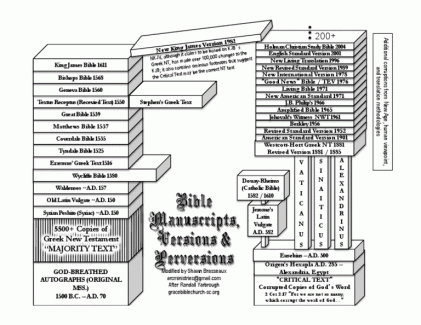
Look alive. The versions on the left may be said to have had a shot at being the Preserved Words of God, by definition.

In case you didn't know it the case for the King James Bible is that we have no doubt that it is, right, and I can't imagine anyone objecting to saying the same thing about all of the rest of them, on the left, which be irrational to consider those on the right, without some great and reasonable reservations that I believe any Confession of Faith worth its weight would have seen clearly to banishing them out of hand as merely spurious in origin and irresponsible, as fleshly, mortal, carnal executions of spurious Original Language Manuscripts.

None of them claim today that we even have the Word of God in writing and don't believe it is possible to have the Word of God in writing. They just say it may be in the original manuscripts somewhere. This is after the initial idea of their production was to give the Word of God, reconstructed, after the previous versions and manuscript evidence on the left were intentionally lied about, to say it was as if they had been corrupted since the first Centuries A.D.

They lied to produce them and didn't produce what they say they set out to do.

You throw out the King James Bible as being the Word of God that we can be sure we have "a more sure Word of God" and then where do you go to find God's Word? Those on the right have already consented utter defeat and ruin in their hopeless efforts to produce for Mankind a Bible that we can say that it is "a more sure Word of God" according to them.

I'll tell you where you go.

You go to the left and the Preserved Linage of the Preserved Word of God that God Himself Promised to Preserve and obviously has.

You talk about the irrelevant "same exact standards/measures are not applied to the textual criticism decisions involved in the making of the KJV", when you don't know what any of those would be, and you're comparing apples to oranges to start with.
BEST GRAPHIC OF VARIOUS MANUSCRIPTS SHOWING ORIGINS OF THE DIFFERENT BIBLE VERSIONS.gif
"Their conclusions are much more destructive than most eccentric
scholarly theories. The motivation for the conclusions in both the case of
Westcott & Hort, and the modern liberal text critics is apostasy (though the
nature of the apostasy is different in the two cases)."
"In this way they use the data at their disposal to discredit God's word. Their false beliefs
have a very real impact on the words that are included in the modern
translations. All modern English Translations use a Greek text that changes
or casts doubt on about one word in twenty of New Testament Scripture.
These changes reflect false doctrines held by early (2nd century) devil-worshipping
heretics. If you want to avoid the modern butchers, you must use the King
James Version.
"Westcott and Hort must have believed that what historians recorded as a
defense against heretics was in reality a suppression of the true church. They
believed that what the historians recorded as heretically corrupted texts were
closer to the true autographs.

"Westcott and Hort did not publicly admit that they thought gnosticism to
be genuine Christianity. The private beliefs of Westcott and Hort are not
primarily at issue here" (or that of where they are now spending Eternity, in Heaven or Hell),
"but rather the evidence that speaks for and against
their major premise. The error of their major premise is demonstrated in that
(1) Westcott and Hort's favored texts bear all the marks of Gnostic
corruptions compared to the traditional text,
(2) the evidence they offer is extremely weak,
(3) the data speaking against their major premise is abundant and powerful.

"Although unnecessary to the refutation of their major premise,
the works of Westcott and Hort, and their biographers have clearly shown that
(4) the beliefs of Westcott and Hort were biased in favor of Gnosticism.

(1) Westcott and Hort's Favored Manuscripts Bear the Marks of Those
Corrupted by Gnostic Adoptionists in the 2nd Century.

"There were two manuscripts Westcott and Hort favored most. The first is
CODEX B (Vaticanus). The second is ALEPH (Sinaiticus). They called these
manuscripts "almost wholly neutral". They deemed the readings of these
"strongly preferred," and said they had the "ring of genuineness".

"It is manifest that these manuscripts bear all the marks of Gnostic corruptions.

"This is evidenced in that they show;
(a) deviations along Gnostic doctrinal lines,
(b) wild discordance with each other
(c) wild discordance with manuscripts of similar age and
(d) wild discordance with the traditional text.

"Since ALEPH and B exhibit the marks of Gnostic corruption, it is clear that
these two manuscripts are depraved." Examination of Modern NT Text Criticism (1/2)

"No other modern translation, to my knowledge, completely
avoids the modern error."
When people are talking about "modern" in the context of Bible versions, you know it a "modernist" issue being discussed, as in context.
The assumptions of the modern Greek New Testament
Text Critics do not represent an approximation to the actual evidence, but a
negation of the actual evidence.

"What You Have to Believe to Accept the Westcott and Hort Theory"

  • "You have to believe that people who believed in the Deity of Christ often corrupt Bible manuscripts.
  • "You have to believe that people who deny the Deity of Christ never corrupt Bible manuscripts.
  • "You have to believe that people who died to get the gospel to the world couldn’t be trusted with the Bible.
  • "You have to believe that their killers could be trusted.
  • "You have to believe that the Celtic Christians, Waldenses, Albigenses, Henricians, Petrobrussians, Paulicians, the Greek Orthodox Church, the Protestant churches, the Anabaptists and the Baptists all did not have the pure word of God.
  • "You have to believe that the Roman Catholics and the nineteenth century rationalists did have the pure word of God."
 

Alan Dale Gross

Well-Known Member
The dark secret they protect is that the
scant evidence they offer does not support their claims.

"John Burgon on Sinaiticus and Vaticanus."

"Rev. Dean John William Burgon was a staunch advocate of the Textus Receptus over the critical texts at the time of Westcott and Hort.

"He collated both the Sinaiticus and the Vaticanus manuscripts personally and therefore knew his subject firsthand. In his book, The Revision Revised (1881), he lists numerous examples of the textual errors found in both the Vaticanus and Sinaiticus.

"On page 11 of his book, Burgon states: "Singular to relate Vaticanus and Aleph have within the last 20 years established a tyrannical ascendance over the imagination of the critics, which can only be fitly spoken of as a blind superstition. It matters nothing that they are discovered on careful scrutiny to differ essentially, not only from ninety-nine out of a hundred of the whole body of extant mss. besides, but even from one another.

"In the gospels alone B (Vaticanus) is found to omit at least 2877 words: to add 536, to substitute, 935; to transpose, 2098: to modify 1132 (in all 7578): -

"the corresponding figures for Aleph being 3455 omitted, 839 added, 1114 substituted, 2299 transposed, 1265 modified (in all 8972).

"And be it remembered that the omissions, additions, substitutions, transpositions, and modifications, are by no means the same in both.

"It is, in fact, easier to find two consecutive verses in which these two mss. differ the one from the other, than two consecutive verses in which they entirely agree."

"On page 319 of he remarks, "In the Gospels alone Vaticanus has 589 readings quite peculiar to itself, affecting 858 words while Aleph has 1460 such readings, affecting 2640 words."

"In his book, Revision Revised, Dean Burgon wrote over a hundred years ago, concerning the ages of Codices Vatican (B) and Sinai (Aleph):

"Quote: "Lastly, - We suspect that these two manuscripts are indebted for their preservation, solely to their ascertained evil character, which has occasioned that the one eventually found its way, four centuries ago, to a forgotten shelf in the Vatican library; while the other, after exercising the ingenuity of several generations of critical Correctors, eventually (viz. in A.D. 1844) got deposited in the waste-paper basket of the Convent at the foot of Mount Sinai. Had b (Vaticanus) and Aleph (Sinaiticus) been copies of average purity, they must long since have shared the inevitable fate of books which are freely used and highly prized; namely, they would have fallen in decadence and disappeared from sight." (Ref: P1)

"In short, these two codices are old simply because, first, they were written on extremely expensive and durable antelope skins, and secondly, they were so full of errors, alterations, and deletions, that they were never used by true believers and seldom even by their own custodians. Thus they had little chance of wearing away." Burgon on Sinaiticus and Vaticanus Textus Receptus Bibles
The same exact standards/measures are not applied to the textual criticism decisions involved in the making of the KJV.
The KJV wasn't a bunch of briars used to try to make fig trees.
The makers of the KJV sometimes used and consulted non-Masoretic OT texts and non-Greek Textus Receptus texts in their textual criticism decisions. The KJV followed some minority readings in its NT text. The English foundation for the KJV was the 1602 edition of the Bishops' Bible, and the book of Psalms in that 1602 edition was from the Great Bible and so it followed several readings from Jerome's Latin Vulgate and the Greek Septuagint.
We appreciate you sharing that with us. If you want to make a point of any of it, consult with your defenseless KJV-Only idols you quote.
English Bible translations such as the 1833 Webster’s Bible, the 1842 revision of the KJV by Baptists, the 1962 Teen-age Version of the Holy Bible by Jay Green, the 1982 NKJV, the 1986 Literal Translation in The Interlinear Bible, the 1990 Modern King James Version, the 1994 21st Century King James Version, the 1998 Third Millennium Bible, the King James 2000 Version, 2000/2013 Jubilee Bible, 2006 New Authorized Version—AV7 NT, the 2010 KJ3 Literal Translation, the 2014 Modern English Version, the 2022 Simplified KJV, Nick Sayers’ 2023 King James Version New Testament, and the 2024 edition of the Modern English Bible can be considered as being based on the same basic multiple original-language Scripture texts as the KJV.
And your point? That "modern" version s were not "based on the same basic multiple original-language Scripture texts as the KJV."

Strong work. Good shot. For those of us who believe the Word of God has been Preserved and was in no need of man's reconstructing it.
The makers of the KJV sometimes used and consulted non-Masoretic OT texts and non-Greek Textus Receptus texts in their textual criticism decisions.
Thank you for that big deal that in no way justifies the editing and altering of the Preserved Word of God, just fo hard cash and all the things the Devil has been using them for in the development of a One World False Church endeaver.
The KJV followed some minority readings in its NT text.
I'm tellin'.
The English foundation for the KJV was the 1602 edition of the Bishops' Bible, and the book of Psalms in that 1602 edition was from the Great Bible and so it followed several readings from Jerome's Latin Vulgate and the Greek Septuagint.
And it's perfect in the sense that it needs no correction any more serious than an "a" to an "an", of Noe to Noah.

And its Authority and those to the left in the chart above are as good as their intrigrity, which are without equal and from God Himself.

They and the KJV need no correction to make them any more God's Word than they are, the KJB Translators just wanted to make a great Bible, better, and they did, despite its and the other Preserved text's innumerable pathetic enemies.
 

Logos1560

Well-Known Member
Site Supporter

"Rev. Dean John William Burgon was a staunch advocate of the Textus Receptus over the critical texts at the time of Westcott and Hort.


Dean John William Burgon wrote: "Once for all, we request it may be clearly understood that we do not, by any means, claim perfection for the Received Text. We entertain no extravagant notions on this subject. Again and again we shall have occasion to point out that the Textus Receptus needs correction" (The Revision Revised, p. 21, footnote 3). John William Burgon maintained that “in not a few particulars, the ‘Textus receptus’ does call for Revision” (p. 107). Burgon wrote: “That some corrections of the Text were necessary, we are well aware” (p. 224, footnote 1). Burgon himself asked: “who in his senses, --what sane man in Great Britain, --ever dreamed of regarding the ‘Received,‘ --aye, or any other known ‘Text,‘ --as a standard from which there shall be no appeal? Have I ever done so? Have I ever implied as much? If I have, show me where” (p. 385). Dean Burgon himself asserted: “If, on the contrary, I have ever once appealed to the ‘Received Text,‘ and made it my standard, --why do you not prove the truth of your allegation by adducing in evidence that one particular instance?“ instead of bringing against me a charge which is utterly without foundation (p. 388). Burgon asked: “Who, pray, since the invention of printing was ever known to put forward any existing Text as ‘a final standard’?“ (p. 392). Burgon asserted: “So far am I from pinning my faith to it [the Textus Receptus], that I eagerly make my appeal from it to the threefold witness of Copies, Versions, Fathers, whenever I find its testimony challenged” (Ibid.). Burgon as edited by Edward Miller asserted: “I am not defending the ‘Textus Receptus’” (Traditional Text of the Holy Gospels, p. 15). Burgon added: “That it is without authority to bind, nay, that it calls for skillful revision in every part, is freely admitted. I do not believe it to be absolutely identical with the true Traditional Text” (Ibid.). Burgon asserted: “Where any part of it conflicts with the fullest evidence attainable, there I believe that it calls for correction” (Ibid.). Edward Miller concluded that the Traditional Text advocated by Dean Burgon would differ “in many passages” from the Textus Receptus (p. 96).

KJV-only author Peter Ruckman referred to Dean Burgon as “the greatest textual authority of the nineteenth century” (Errors, p. 441). KJV defender Edward F. Hills claimed: “Burgon laid down the principles of consistently Christian New Testament textual criticism” (Fuller, Which Bible, fifth edition, p. 88). Edward F. Hills maintained that John William Burgon “followed a consistently Christian method of New Testament textual criticism” (fifth edition, p. 101; second edition, p. 64). Edward F. Hills affirmed that Burgon’s views concerning the NT text “are consistently Christian” (KJV Defended, p. 142; Text, p. 246). Do KJV-only advocates agree with and follow Burgon “consistently Christian method of New Testament textual criticism”?

In the introduction to another of Burgon’s books, Edward Miller asserted: “The Traditional Text must be found, not in a mere transcript, but in a laborious revision of the Received Text” (Causes of the Corruption of the Traditional Text, p. 1). In 1864, John William Burgon maintained that “the accumulated evidence of the last two centuries has enabled us to correct it [the Textus Receptus] with confidence in hundreds of places” (Treatise on the Pastoral Office, p. 69). Burgon noted: “GOD has not seen fit to work a succession of miracles for the protection even of His Word” (p. 64). Burgon claimed: “To some, it may seem a matter of regret that a perpetual miracle has not guarded the ispissma verba of the Spirit; but the wiser will judge differently” (p. 77). Burgon asserted: “From the very nature of the case, he who transcribes a MS. must fall into error sometimes” (p. 66).

John William Burgon maintained “that the number of various readings in the New Testament properly so called has been greatly exaggerated,” and he asserted that “in reality they are exceedingly few in number” (Causes of the Corruption, p. 16; Green, UnHoly Hands, I, p. B-5). Burgon asserted: "Let it be also candidly admitted that even where (in our judgment) the Revisionists have erred, they have never had the misfortune seriously to obscure a single feature of Divine Truth" (Revision Revised, p. 232). Burgon as edited by Edward Miller wrote: “It may be regarded as certain that most of the aberrations discoverable in the Codexes of the Sacred Text have arisen in the first instance from the merest inadvertency of the scribes” (Causes of the Corruption, p. 21). John William Burgon wrote: “The Greek text ordinarily in use is that of Stephens, put forth at Paris in 1550” (Treatise on the Pastoral Office, p. 69). John William Burgon wrote: “The Greek text, as we have it in any ordinary edition, (that of Bp. Lloyd, for example, who reproduced that of Mill (1707), which is very nearly that of Stephens (1550),) is known to be generally correct, --quite correct enough for all practical purposes” (p. 70). Burgon wrote: “S. Luke’s history of the Temptation (4:8) contains five words which some ancient copyist must have inserted from remembering too well the parallel place in S. Matthew 4:10, and confounding it with the language of S. Matthew 16:23” (p. 76).

Edward Miller noted: “Dean Burgon has incurred much misrepresentation. He does not maintain the faultlessness of the Received Text” (Guide to the Textual Criticism, p. 33). Baptist pastor Glenn Conjurske (1947-2001) maintained that KJV defenders “have read Burgon without half understanding him—though indeed he is not hard to understand—and have coupled his protest with the most invincible ignorance and the most arrogant prejudice. And they have crippled Burgon’s protest, by saddling it with a host of the most baseless of fictions” (Olde Paths, April, 1995, p. 75; Bible Version Controversy, p. 156). Glenn Conjurske asserted that the stand of the Dean Burgon Society “is far away from anything which Burgon held” (May, 1996, p. 100). Glenn Conjurske observed that Burgon “believed that there were inaccuracies and mistranslations in the King James Version and that the Revised Version remedied some of them” (p. 102). Glenn Conjurske contended that “in our own generation there are a great many who suppose that they hold Burgon’s view, but who in fact hold a view which Burgon had nothing to do with” (Bible Version, p. 165). Glenn Conjurske maintained that “Burgon never applied his doctrine to any printed Greek New Testament, nor to any single manuscript, but held that the true text was dispersed in all the manuscripts, to be ferreted out and established by patient and painstaking labor, to which he gave much of his life” (Ibid., p. 166).
 

Logos1560

Well-Known Member
Site Supporter
Your entire life is based on playing with a stacked deck and, btw, playing straight into the hand of the devil.

I'll tell you where you go.

You go to the left and the Preserved Linage of the Preserved Word of God that God Himself Promised to Preserve and obviously has.


View attachment 14190
You disobey a clear command of God as you bear false witness by making false accusations. I do not go to the left of the standard of the preserved Scriptures in the original languages. You throw out strawman distortions and misrepresentations that do not at all present accurately my consistent, scripturally-based views concerning Bible translations.

Shawn Brasseaux, the modifier of the chart, is misinformed, and his chart is misleading and inaccurate. The Syriac Peshitta has significant textual differences with the Textus Receptus [far greater differences than any supposedly found in the NKJV]. The Old Latin Vulgate's Old Testament was based on the old Greek Septuagint so that it has many significant textual differences with the Hebrew Masoretic Text. The translations used by the Waldenses were for the most part based on Jerome's Latin Vulgate, and they have far greater and more significant differences with the KJV than the NKJV supposedly has. The old Wycliffe Bible 1380 was based on Jerome's Latin Vulgate, and the Wycliffe Bible differs far more with the KJV than the NKJV supposedly does. Verifiable facts from the Bibles listed on this misleading chart would refute Brasseaux's own KJV-only claims and arguments.

Shawn Brasseaux bears false witness against the believers who made the NKJV. Perhaps Shawn Brasseaux has played into the hands of the devil as he became in effect a false accuser of the brethren (the believers who made the NKJV). The textual NT footnotes in many NKJV editions do not suggest that the Critical Text is the correct text. There are editions of the NKJV that do not have the textual footnotes. Arthur Farstad, executive editor of the NKJV, favored the Majority Text so he may have believed that the MT footnotes indicate the correct NT text but he did not believe that the CT footnotes did. The KJV may follow NT readings found in less than 50% of the preserved Greek NT manuscripts in as many as 1,000 to 1,800 places.

The NKJV translators did not make 100,000 textual changes to the KJV. No KJV-only author has listed or proven 100,000 changes in the NKJV as this wild estimate or speculation alleges. Most of the alleged changes of words in the NKJV would involve the updating of archaic English in the KJV such as updating or removing the archaic spellings, the archaic verb forms that end in "eth" etc., and updating the archaic second person pronouns to standard present second person pronouns. David Crystal identified begat as the “archaic past-tense of beget” (Begat, p. 43), and it is used 225 times in the KJV. The verb shalt is considered an archaic verb form, and it is found 1,616 times in the KJV. Consider the number of times the KJV uses what are considered archaic pronouns such as thou, thee, thy, thine, thyself, and ye. Thou is used over 5,400 times, thy over 4,500 times, thee over 3,800 times, ye over 3,700 times, thine over 900 times, and thyself over 200 times. One archaic preposition unto may be used over 9,000 times in the KJV. Shawn Brasseaux seems to be making invalid apples and oranges comparisons as he in effect mixes together updating or translation differences with textual differences in throwing out his unproven and unsupported 100,000 changes number.
 
Last edited:
Top