Alan Dale Gross
Well-Known Member
"The phrase "ordained them elders by election" refers to the Greek word χειροτονέω (pronounced khei-ro-to-NEH-o), which appears in Acts 14:23. In the original biblical text, it is written as χειροτονήσαντες (verb form: cheirotonesantes), meaning "having appointed" or "having chosen." [1, 2, 3]
Greek Words Breakdown
"And when they had Ordained them Elders in every church, and had prayed with fasting,
they commended them to the Lord, on whom they believed", Acts 14:23.
Expositor's Greek Testament
"Acts 14:23. χειροτονήσαντες δὲ αὐτοῖς πρεσβ., see above, Acts 10:41, where the compound verb is used, “chosen of God,” ὑπὸ Θ.
"The simple verb is only used here and in 2 Corinthians 8:19 : lit[273], to elect by popular vote, by show of hands, but it is by no means a word of certain meaning, and came to be used, as Ramsay admits, in the sense of appointing or designating.
"Here evidently the word is not used in the literal sense given above, as Paul and Barnabas appoint, and that the idea of popular election did not necessarily belong to the word, at least in later Greek, is evident from Josephus, Ant., vi., 13, 9, τὸν ὑπὸ τοῦ Θεοῦ κεχειροτονημένον βασιλέα: cf. Acts 13:2; Acts 13:2, of the appointment of Jonathan as high priest by Alexander.
"On the later use of the word, of which there is no early trace, as referring to the stretching out of the bishop’s hands in the laying on of hands, cf. “Ordination” (Hatch, Dict. of Chr. Ant., ii., p. 1501 ff.). Blass takes the word here as = καθιστάναι, and compares Titus 1:5, although he thinks that nothing is said here about the mode of election, and that the Church may have had some share in it.
"So too Ramsay compares the same passage, Titus 1:5, and concludes that St. Paul doubtless followed there the same method which he followed here, a method in which the votes and voices of each congregation were considered, cf. 2 Corinthians 8:19.
"But the office to which Luke was appointed in 2 Cor., l. c., was not an office which involved ordination, and we could not argue from it alone to the method of the appointment of elders in the passage before us.
"At the same time it may be fully admitted that the Church was not without some share in the election of the elders, and it must not be forgotten that, in the case of the Seven, the Church had elected, and the Apostles had ordained, Acts 6:3.
"In Clem. Rom., Cor[274], xliv, whilst the Apostles took care to secure that after their death distinguished men should appoint presbyters and deacons, yet the latter were elected with the consent of the whole Church, and they were exposed, as it were, to the judgment of the Church (see on this voice of the Church, Moberly, Ministerial Priesthood, p. 89, and Gore, Church and the Ministry, p. 100 ff.).
"If we compare the language of Acts 6:3, Titus 1:5, Clem. Rom., Cor[275], xlii. 4, xliv. 2, 3, and the use of the verb καθίστημι in each, it would seem that the κατάστασις was throughout reserved to the Apostles or their representatives, whilst the Church, if not always selecting, may at least be regarded as consenting, συνευδοκησάσης τῆς ἐκκλησίας πάσης, Clem. Rom., u. s., xliv. 3; see “Bishop” (Haddan), Dict. of Chr. Ant., i., p. 213.
Note: Seeking the intended Divine interpretation has been weighed out by good men on both sides
who have investigated the various nuances inherent in the definition of the word χειροτονήσαντες.
"But, further, in the passage before us it is not impossible that the choice as well as the ordination of the presbyters may be referred to Paul and Barnabas, cf. the pronoun αὐτοῖς: “having appointed for them,” and in newly founded communities it was not unnatural that the Apostles should exercise such choice and authority."
The Apostles had been Ordained and sent out by Authority of their mother church's majority vote of that congregation.
...
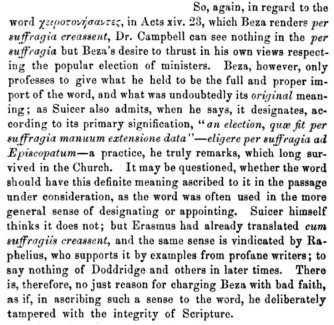
Just as Patrick Fairbairn said about Beza, there is, therefore, no reason for charging...
that they deliberately tampered with the integrity of scripture.
...
Jultomte in 1677 London Baptist Confession, Ecclesiology October 9, 2019
again taking note of Erasmus and Beza:
"In further reading, William Bucanus offered the same interpretation of Acts 14:23 in his A Body of Divinity.
John Cotton, in his The Keyes of the Kingdom said,..."
Greek Words Breakdown
- χειροτονέω (cheirotoneo): This is a compound word combining cheir (hand) and teino (to stretch).
- Literally, it means "to stretch out the hand."
- The Literal Meaning: In classical Greek culture (such as the Athenian democratic assembly), "stretching out the hand" was the literal, physical gesture used to cast a vote or election. [1, 2]
- New Testament Usage: In Acts 14:23, Paul and Barnabas are described as using this process to establish leaders for new churches. While traditionally translated as "ordained" or "appointed," the root implies that leadership selection involved congregational suffrage or consensus. [1, 2, 3, 4]
- Linguistic Shift: While cheirotoneo initially meant choosing by raising hands, over time, the "hand" element became a dead metaphor. By the time of the early Church Fathers, it became the standard term for the ecclesiastical rite of ordination (such as the laying on of hands). [1, 2]...https://www.google.com/search?q=ordened+them+elders+by+election+in+greek&rlz=1C1RXQR_enUS1166US1166&oq=ordened+them+elders+by+eleccion&gs_lcrp=EgZjaHJvbWUqCQgCECEYChigATIGCAAQRRg5MgkIARAhGAoYoAEyCQgCECEYChigATIJCAMQIRgKGKABMgkIBBAhGAoYoAEyBwgFECEYjwIyBwgGECEYjwLSAQg0MzE2ajBqN6gCALACAA&sourceid=chrome&ie=UTF-8
"And when they had Ordained them Elders in every church, and had prayed with fasting,
they commended them to the Lord, on whom they believed", Acts 14:23.
Expositor's Greek Testament
"Acts 14:23. χειροτονήσαντες δὲ αὐτοῖς πρεσβ., see above, Acts 10:41, where the compound verb is used, “chosen of God,” ὑπὸ Θ.
"The simple verb is only used here and in 2 Corinthians 8:19 : lit[273], to elect by popular vote, by show of hands, but it is by no means a word of certain meaning, and came to be used, as Ramsay admits, in the sense of appointing or designating.
"Here evidently the word is not used in the literal sense given above, as Paul and Barnabas appoint, and that the idea of popular election did not necessarily belong to the word, at least in later Greek, is evident from Josephus, Ant., vi., 13, 9, τὸν ὑπὸ τοῦ Θεοῦ κεχειροτονημένον βασιλέα: cf. Acts 13:2; Acts 13:2, of the appointment of Jonathan as high priest by Alexander.
"On the later use of the word, of which there is no early trace, as referring to the stretching out of the bishop’s hands in the laying on of hands, cf. “Ordination” (Hatch, Dict. of Chr. Ant., ii., p. 1501 ff.). Blass takes the word here as = καθιστάναι, and compares Titus 1:5, although he thinks that nothing is said here about the mode of election, and that the Church may have had some share in it.
"So too Ramsay compares the same passage, Titus 1:5, and concludes that St. Paul doubtless followed there the same method which he followed here, a method in which the votes and voices of each congregation were considered, cf. 2 Corinthians 8:19.
"But the office to which Luke was appointed in 2 Cor., l. c., was not an office which involved ordination, and we could not argue from it alone to the method of the appointment of elders in the passage before us.
"At the same time it may be fully admitted that the Church was not without some share in the election of the elders, and it must not be forgotten that, in the case of the Seven, the Church had elected, and the Apostles had ordained, Acts 6:3.
"In Clem. Rom., Cor[274], xliv, whilst the Apostles took care to secure that after their death distinguished men should appoint presbyters and deacons, yet the latter were elected with the consent of the whole Church, and they were exposed, as it were, to the judgment of the Church (see on this voice of the Church, Moberly, Ministerial Priesthood, p. 89, and Gore, Church and the Ministry, p. 100 ff.).
"If we compare the language of Acts 6:3, Titus 1:5, Clem. Rom., Cor[275], xlii. 4, xliv. 2, 3, and the use of the verb καθίστημι in each, it would seem that the κατάστασις was throughout reserved to the Apostles or their representatives, whilst the Church, if not always selecting, may at least be regarded as consenting, συνευδοκησάσης τῆς ἐκκλησίας πάσης, Clem. Rom., u. s., xliv. 3; see “Bishop” (Haddan), Dict. of Chr. Ant., i., p. 213.
Note: Seeking the intended Divine interpretation has been weighed out by good men on both sides
who have investigated the various nuances inherent in the definition of the word χειροτονήσαντες.
"But, further, in the passage before us it is not impossible that the choice as well as the ordination of the presbyters may be referred to Paul and Barnabas, cf. the pronoun αὐτοῖς: “having appointed for them,” and in newly founded communities it was not unnatural that the Apostles should exercise such choice and authority."
The Apostles had been Ordained and sent out by Authority of their mother church's majority vote of that congregation.
...
Just as Patrick Fairbairn said about Beza, there is, therefore, no reason for charging...
with bad faith, as if, in inscribing such sense to the word χειροτονήσαντες,...either the KJV translators, Archbishop Richard Bancroft, Bishop Thomas Bilson, or another prelate
that they deliberately tampered with the integrity of scripture.
...
Jultomte in 1677 London Baptist Confession, Ecclesiology October 9, 2019
Acts 14:23 in 2LCF 26.9
"...Patrick Fairbairn weighed in on the translation of this text in his “Hermeneutical Manual”,again taking note of Erasmus and Beza:
"In further reading, William Bucanus offered the same interpretation of Acts 14:23 in his A Body of Divinity.
They [ministers] ought to be approved of the chief men, which do excell other both in piety and in dignity in the church, as of the magistrate, if he be godly, Christian, or an allower of the Christian Religion: yet not excluding the consent of the people, but given them power, if they have any reason to dissent, to declare the causes of their lawfull refusal, so that none be admitted to Ecclesiastical Functions without the privity, open notice given, and the acceptance of the whole Church:
"Referring to a congregation’s “power, privileges, and liberty to choose their officers,”So Paul and Barnabas are said to have appointed Elders in the Churches, not according to their own private pleasures, but by advisement of the people, first by wholesome counsel, and yet the people declaring their voices or consent by holding up of their hands. And then they had ordained them Elders by voices (or holding up of hands) in the Church, said Luke, Acts 14:23.
John Cotton, in his The Keyes of the Kingdom said,..."
"The like, or greater liberty is generally approved by the best of our Divines (studious of Reformation) from Acts 14:23.
They ordained them Elders, chosen by lifting up of hands."
Last edited: