• Welcome to Baptist Board, a friendly forum to discuss the Baptist Faith in a friendly surrounding.

    Your voice is missing! You will need to register to get access to all the features that our community has to offer.

    We hope to see you as a part of our community soon and God Bless!

Is the KJV's rendering the most accurate in these ten passages?

Alan Dale Gross

Well-Known Member
"The phrase "ordained them elders by election" refers to the Greek word χειροτονέω (pronounced khei-ro-to-NEH-o), which appears in Acts 14:23. In the original biblical text, it is written as χειροτονήσαντες (verb form: cheirotonesantes), meaning "having appointed" or "having chosen." [1, 2, 3]

Greek Words Breakdown
  • χειροτονέω (cheirotoneo): This is a compound word combining cheir (hand) and teino (to stretch).
  • Literally, it means "to stretch out the hand."
Historical and Biblical Context
  • The Literal Meaning: In classical Greek culture (such as the Athenian democratic assembly), "stretching out the hand" was the literal, physical gesture used to cast a vote or election. [1, 2]
  • New Testament Usage: In Acts 14:23, Paul and Barnabas are described as using this process to establish leaders for new churches. While traditionally translated as "ordained" or "appointed," the root implies that leadership selection involved congregational suffrage or consensus. [1, 2, 3, 4]
  • Linguistic Shift: While cheirotoneo initially meant choosing by raising hands, over time, the "hand" element became a dead metaphor. By the time of the early Church Fathers, it became the standard term for the ecclesiastical rite of ordination (such as the laying on of hands). [1, 2]...https://www.google.com/search?q=ordened+them+elders+by+election+in+greek&rlz=1C1RXQR_enUS1166US1166&oq=ordened+them+elders+by+eleccion&gs_lcrp=EgZjaHJvbWUqCQgCECEYChigATIGCAAQRRg5MgkIARAhGAoYoAEyCQgCECEYChigATIJCAMQIRgKGKABMgkIBBAhGAoYoAEyBwgFECEYjwIyBwgGECEYjwLSAQg0MzE2ajBqN6gCALACAA&sourceid=chrome&ie=UTF-8
...

"And when they had Ordained them Elders in every church, and had prayed with fasting,
they commended them to the Lord, on whom they believed", Acts 14:23.


Expositor's Greek Testament

"Acts 14:23. χειροτονήσαντες δὲ αὐτοῖς πρεσβ., see above, Acts 10:41, where the compound verb is used, “chosen of God,” ὑπὸ Θ.

"The simple verb is only used here and in 2 Corinthians 8:19 : lit[273], to elect by popular vote, by show of hands, but it is by no means a word of certain meaning, and came to be used, as Ramsay admits, in the sense of appointing or designating.


"Here evidently the word is not used in the literal sense given above, as Paul and Barnabas appoint, and that the idea of popular election did not necessarily belong to the word, at least in later Greek, is evident from Josephus, Ant., vi., 13, 9, τὸν ὑπὸ τοῦ Θεοῦ κεχειροτονημένον βασιλέα: cf. Acts 13:2; Acts 13:2, of the appointment of Jonathan as high priest by Alexander.

"On the later use of the word, of which there is no early trace, as referring to the stretching out of the bishop’s hands in the laying on of hands, cf. “Ordination” (Hatch, Dict. of Chr. Ant., ii., p. 1501 ff.). Blass takes the word here as = καθιστάναι, and compares Titus 1:5, although he thinks that nothing is said here about the mode of election, and that the Church may have had some share in it.

"So too Ramsay compares the same passage, Titus 1:5, and concludes that St. Paul doubtless followed there the same method which he followed here, a method in which the votes and voices of each congregation were considered, cf.
2 Corinthians 8:19.

"But the office to which Luke was appointed in 2 Cor., l. c., was not an office which involved ordination, and we could not argue from it alone to the method of the appointment of elders in the passage before us.

"At the same time it may be fully admitted that the Church was not without some share in the election of the elders, and it must not be forgotten that, in the case of the Seven, the Church had elected, and the Apostles had ordained, Acts 6:3.

"In Clem. Rom., Cor[274], xliv, whilst the Apostles took care to secure that after their death distinguished men should appoint presbyters and deacons, yet the latter were elected with the consent of the whole Church, and they were exposed, as it were, to the judgment of the Church (see on this voice of the Church, Moberly, Ministerial Priesthood, p. 89, and Gore, Church and the Ministry, p. 100 ff.).

"If we compare the language of Acts 6:3, Titus 1:5, Clem. Rom., Cor[275], xlii. 4, xliv. 2, 3, and the use of the verb καθίστημι in each, it would seem that the κατάστασις was throughout reserved to the Apostles or their representatives, whilst the Church, if not always selecting, may at least be regarded as consenting, συνευδοκησάσης τῆς ἐκκλησίας πάσης, Clem. Rom., u. s., xliv. 3; see “Bishop” (Haddan), Dict. of Chr. Ant., i., p. 213.

Note: Seeking the intended Divine interpretation has been weighed out by good men on both sides
who have investigated the various nuances inherent in the definition of the word χειροτονήσαντες.


"But, further, in the passage before us it is not impossible that the choice as well as the ordination of the presbyters may be referred to Paul and Barnabas, cf. the pronoun αὐτοῖς: “having appointed for them,” and in newly founded communities it was not unnatural that the Apostles should exercise such choice and authority."

The Apostles had been Ordained and sent out by Authority of their mother church's majority vote of that congregation.

...

Just as Patrick Fairbairn said about Beza, there is, therefore, no reason for charging...
...either the KJV translators, Archbishop Richard Bancroft, Bishop Thomas Bilson, or another prelate
with bad faith, as if, in inscribing such sense to the word χειροτονήσαντες,
that they deliberately tampered with the integrity of scripture.

...

Jultomte in 1677 London Baptist Confession, Ecclesiology October 9, 2019

Acts 14:23 in 2LCF 26.9

"...Patrick Fairbairn weighed in on the translation of this text in his Hermeneutical Manual,
again taking note of Erasmus and Beza:
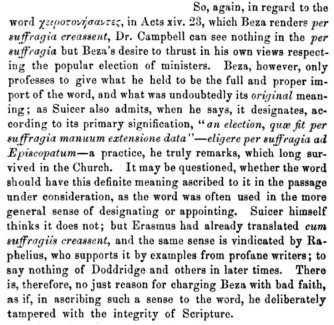
fairbairn.jpg
"In further reading, William Bucanus offered the same interpretation of Acts 14:23 in his A Body of Divinity.
They [ministers] ought to be approved of the chief men, which do excell other both in piety and in dignity in the church, as of the magistrate, if he be godly, Christian, or an allower of the Christian Religion: yet not excluding the consent of the people, but given them power, if they have any reason to dissent, to declare the causes of their lawfull refusal, so that none be admitted to Ecclesiastical Functions without the privity, open notice given, and the acceptance of the whole Church:
So Paul and Barnabas are said to have appointed Elders in the Churches, not according to their own private pleasures, but by advisement of the people, first by wholesome counsel, and yet the people declaring their voices or consent by holding up of their hands. And then they had ordained them Elders by voices (or holding up of hands) in the Church, said Luke, Acts 14:23.
"Referring to a congregation’s “power, privileges, and liberty to choose their officers,”
John Cotton, in his The Keyes of the Kingdom said,..."
"The like, or greater liberty is generally approved by the best of our Divines (studious of Reformation) from Acts 14:23.
They ordained them Elders, chosen by lifting up of hands."
 
Last edited:

Alan Dale Gross

Well-Known Member
Where's your equal measures and standards on what you accuse the KJV makers of here???
the makers of the KJV remove vital words or phrases
in Acts 14:23 where either the KJV translators, Archbishop Richard Bancroft, Bishop Thomas Bilson, or another prelate omitted the words "by election" found in Tyndale's New Testament, Coverdale's Bible, Matthew's Bible, Great Bible, Taverner's Bible, Jugge’s New Testament, Whittingham’s New Testament, Geneva Bible, and Bishops' Bible ("ordained them elders by election").
You seem terribly concerned "by leaving out the two words 'by election'" which you say were "mutilated and corrupted by James’s revisers", although "by election", is not in the interlinear, above, or any Greek manuscripts, and are just redundant words added, which are understood and implied within χειροτονήσαντες;
3 5500 [e]
23 cheirotonēsantes
23 χειροτονήσαντες
23 having chosen
23 V-APA-NMP
“This all-important text [Acts 14:23] was mutilated and corrupted by James’s revisers, by leaving out the two words ’by election;’
Do you see anything like "ορισμός | στα ισπανικά | στα γαλλικά | συνώνυμα στα αγγλικά" in these Greek texts?;

Greek Texts

ΠΡΑΞΕΙΣ 14:23 Greek NT: Nestle 1904
χειροτονήσαντες δὲ αὐτοῖς κατ’ ἐκκλησίαν πρεσβυτέρους, προσευξάμενοι μετὰ νηστειῶν παρέθεντο αὐτοὺς τῷ Κυρίῳ εἰς ὃν πεπιστεύκεισαν.

ΠΡΑΞΕΙΣ 14:23 Greek NT: Westcott and Hort 1881
χειροτονήσαντες δὲ αὐτοῖς κατ' ἐκκλησίαν πρεσβυτέρους προσευξάμενοι μετὰ νηστειῶν παρέθεντο αὐτοὺς τῷ κυρίῳ εἰς ὃν πεπιστεύκεισαν.

ΠΡΑΞΕΙΣ 14:23 Greek NT: Westcott and Hort / [NA27 and UBS4 variants]
χειροτονήσαντες δὲ αὐτοῖς κατ' ἐκκλησίαν πρεσβυτέρους προσευξάμενοι μετὰ νηστειῶν παρέθεντο αὐτοὺς τῷ κυρίῳ εἰς ὃν πεπιστεύκεισαν.

ΠΡΑΞΕΙΣ 14:23 Greek NT: RP Byzantine Majority Text 2005
Χειροτονήσαντες δὲ αὐτοῖς πρεσβυτέρους κατ’ ἐκκλησίαν, προσευξάμενοι μετὰ νηστειῶν, παρέθεντο αὐτοὺς τῷ κυρίῳ εἰς ὃν πεπιστεύκεισαν.

ΠΡΑΞΕΙΣ 14:23 Greek NT: Greek Orthodox Church
χειροτονήσαντες δὲ αὐτοῖς πρεσβυτέρους κατ’ ἐκκλησίαν καὶ προσευξάμενοι μετὰ νηστειῶν παρέθεντο αὐτοὺς τῷ Κυρίῳ, εἰς ὃν πεπιστεύκασι.

ΠΡΑΞΕΙΣ 14:23 Greek NT: Tischendorf 8th Edition
χειροτονήσαντες δὲ αὐτοῖς κατ’ ἐκκλησίαν πρεσβυτέρους προσευξάμενοι μετὰ νηστειῶν παρέθεντο αὐτοὺς τῷ κυρίῳ εἰς ὃν πεπιστεύκεισαν.

ΠΡΑΞΕΙΣ 14:23 Greek NT: Scrivener's Textus Receptus 1894
χειροτονήσαντες δὲ αὐτοῖς πρεσβυτέρους κατ’ ἐκκλησίαν, προσευξάμενοι μετὰ νηστειῶν, παρέθεντο αὐτοὺς τῷ Κυρίῳ εἰς ὃν πεπιστεύκεισαν.

ΠΡΑΞΕΙΣ 14:23 Greek NT: Stephanus Textus Receptus 1550
χειροτονήσαντες δὲ αὐτοῖς πρεσβυτέρους κατ' ἐκκλησίαν προσευξάμενοι μετὰ νηστειῶν παρέθεντο αὐτοὺς τῷ κυρίῳ εἰς ὃν πεπιστεύκεισαν

Acts 14:23 Greek Study Bible (Apostolic / Interlinear)
χειροτονήσαντες δὲ αὐτοῖς κατ’ ἐκκλησίαν πρεσβυτέρους, προσευξάμενοι μετὰ νηστειῶν παρέθεντο αὐτοὺς τῷ κυρίῳ εἰς ὃν πεπιστεύκεισαν.

KJV with Strong's
"And when they had ordained them elders in every church and had prayed with fasting
they commended them to the Lord on whom they believed"
 

Alan Dale Gross

Well-Known Member
And you should be thrilled to hear of those that arbitrarily change the meaning of certain Bible texts, removes vital words and phrases from certain passages, and diminish the Authority of the Bible.
The serious problem and alarming inadequacy with KJV-only articles and books is their dependance upon fallacies and their use of double standards as they fail to apply their exact same standards or measures that they use to accuse post-1611 English Bibles to the KJV itself.

Tell everyone so they will know that maybe you should consider the removal of 15 entire verses an enormously more serious problem and alarming inadequacy in the Modern Bibles, just for starters, compared to 'two words' that were supplied in only a half dozens versions that you consider to have been "omitted", with your utter dependence upon fallacies and your use of genuine double standards as you fail to apply your exact same standards or measures that you use to accuse the King James English Bible itself.

Please, share with us how terribly distraught you are about;​

Sixteen Verses Omitted from Modern Bibles

and that you demand to know how they could have let this happen.​


Here are the sixteen whole verses:
  1. Matthew 17:21: "Howbeit this kind goeth not out but by Prayer and Fasting."
  2. Matthew 18:11: "For the Son of man is Come to Save that which was lost."
  3. Matthew 23:14: "Woe unto you, Scribes and Pharisees, hypocrites! for ye devour widows' houses, and for a pretence make long prayer: therefore ye shall receive the greater Damnation."
  4. Mark 7:16: "If any man have ears to Hear, let him Hear."
  5. Mark 9:44: "Where their worm dieth not, and the Fire is not quenched."
  6. Mark 9:46: "Where their worm dieth not, and the Fire is not quenched."
  7. Mark 11:26: "But if ye do not forgive, neither will your Father which is in Heaven Forgive your trespasses."
  8. Mark 15:28: "And the Scripture was Fulfilled, which saith, And He was numbered with the transgressors."
  9. Luke 17:36: "Two men shall be in the field; the one shall be taken, and the other left."
  10. John 5:4: "For an Angel went down at a certain season into the pool, and troubled the water: whosoever then first after the troubling of the water stepped in was made whole of whatsoever disease he had."
  11. Acts 8:37: "And Philip said, If thou believest with all thine heart, thou mayest. And he answered and said, I believe that Jesus Christ is the Son of God."
  12. Acts 15:34: "Notwithstanding it pleased Silas to abide there still."
  13. Acts 24:7: "But the chief captain Lysias came upon us, and with great violence took Him away out of our hands,"
  14. Acts 28:29: "And when He had said these words, the Jews departed, and had great reasoning among themselves."
  15. Romans 16:24: "The Grace of our Lord Jesus Christ be with you all. Amen."
  16. I John 5:7: "For there are Three that Bear Record in Heaven, the Father, the Word, and the Holy Ghost: and these Three are One."
"It is important to read the surrounding scriptures
to get an understanding of the impact the omission of the above verses really have."
Perhaps using the fallacy of begging the question, those biased articles often assume the KJV to be the standard in and of itself instead of comparing the KJV and other English Bible translations to the proper standard of the preserved Scriptures in the original languages.
You want to know how smart you are?

Bring out those preserved Scriptures that the Modern Bible translators ignorantly dismissed out of hand,
based on the intentional lie they were spurious.
 

Alan Dale Gross

Well-Known Member
So, they have to pretend to define, find, and rescue the World from "problems", with God's Fulfilled Promise to Supernaturally Preserve His Word in the Universally Recognized version of The Holy Bible of over Four-Hundred years, by first framing their marketing ploy into associating anyone who uses the King James Version, with the Cult of Ruckmanism, and "lie in wait to deceive", in the exact same manner in which Peter Ruckman was, in his day, "traveling about with the sole intention to deceive."*

*Peter Ruckman - Dangerous Deceiver and False Prophet - Part 1

"That we henceforth be no more children, tossed to and fro, and carried about with every wind of Doctrine,
by the sleight of men, and cunning craftiness, whereby they lie in wait to deceive;

But speaking the Truth in Love, may grow up into Him in all things, which is the Head, even Christ:" (Ephesians 4:14)
Your own posts demonstrate that you believe some non-scriptural KJV-only reasoning/teaching.
According to your jaded bias needed for your kangaroo Bully Pulpit.
It is your own statements that would identify your view as KJV-only.
According to your half-baked, decreped, sacriligious, and jaded bias needed for your kangaroo Bully Pulpit.

Don't bother trying to show 'where', because you'll only disclose your deceit with additional clarification.

After showing their dependence upon their deception of unceremoniously placing all Bible readers who prefer the Supernaturally Inspired Superiority of the King James Bible**, into the "King James Only Camp" of Peter Ruckman's heresies, and presumably dismissing them all, "Like shooting fish in a barrel", they next proceed to embarrass themselves by bragging on their ignorance, if not just being illiterate, of the English Language and others, also.

**(remind me to illustrate this to you).
There was the reminder, or two. There will be plenty more, because that is all he's got.

An simpleton Smear Campaign too cheap to talk about.

You do not apply the same exact measures/standards to the many varying editions of the KJV that you inconsistently and unjustly apply to post-1611 English Bibles. I soundly apply the same measures/standards to the KJV that KJV-only advocates apply to other post-1611 English Bibles. The truth is consistent while KJV-only reasoning/teaching is inconsistent.
Show me where you ever "soundly apply the same measures/standards" to the Modern Bibles' omitting vital Bible Doctrinal words from the Bible which are essential characteristics that define Christianity, such as;
"Christ, Lord, Jesus, God, Godhead, Lucifer, devil(s), hell, heaven, damned (-able, -ation), blood, salvation,
Word of God, Word of the Lord, and The Lord Jesus Christ"
, as below.

Table of Changes: Over 2,000 to Over 17,000 Changes.​

Differs from the King James Bible
in the New Testament
o = Omitts Word(s)
a = Adds
NKJV
NIV
NASV
NRSV
RSV
NCV
LIV
WORDS
o 2289​
o 5219​
a 3561​
o 3890​
o 6985​
a 11114​
a 17003​
VERSES
0​
o 16​
o 17​
o 18​
o 25​
o 16​
o 7​


The number of times
15 Major words differ
from the King James Bible
o = Omits Word(s)​
a = Adds
Word(s)​
* = Word(s)
Completely
Removed​
WORD
NIV
NASV
NKJV
RSV
NRSV
NCV
LIV
Christo 25o 34o 1o 32o 87a 121a 44
Lordo 352o 438o 66o 36o 91o 299o 2368
Jesusa 292o 64o 2o 53a 16a 1098a 293
Godo 468o 87o 51o 111o 138a 803a 452
Godheado 3 *o 3 *o 1o 3 *o 3 *o 3 *o 3 *
Lucifero 1 *o 1 * o 1 *o 1 *o 1 *
devil(s)o 80o 82o 81o 82o 80o 74o 87
hello 40o 41o 22o 41o 41o 39a 13
heaveno 160o 127o 50o 83o 88o 186o 26
damned (able, ation)o 15 *o 15 *o 15 *o 15 *o 15 *o 15 *o 7
bloodo 41o 39o 23o 26o 46o 157o 174
salvationo 42o 4o 2o 33o 37o 94o 25
Word of Godo 8o 2o 1o 3o 8o 31o 27
Word of the Lordo 25o 2a 4o 2o 3o 217o 236
Lord Jesus Christo 24o 21 o 21o 22o 20o 15
 

Logos1560

Well-Known Member
Site Supporter
According to your jaded bias needed for your kangaroo Bully Pulpit.

According to your half-baked, decreped, sacriligious, and jaded bias needed for your kangaroo Bully Pulpit.

Don't bother trying to show 'where', because you'll only disclose your deceit with additional clarification.

An simpleton Smear Campaign too cheap to talk about.


You have proven no deceit and no "smear campaign" in my accurate statements. You prove no misrepresentation of your views in my posts. You improperly attack me for believing that you believe what you yourself post. It is your own assertions that demonstrate that you hold to a form of KJV-only reasoning/teaching.

There could be intended deception in your false accusations and your bogus attempts to misrepresent and smear me.

My bias is for the KJV, which I have read and studied for over 60 years.

I have not recommended nor advocated the Critical Text nor English Bible translations made from it as you improperly try to associate me with it. I repeatedly have advocated applying the same exact measures/standards consistently and justly. I properly take the same exact measures and standards used by KJV-only advocates and attempt to apply them to the KJV in order to demonstrate the KJV-only use of double standards.

You fail to apply the same exact measures/standards to the KJV that you attempt inconsistently and unjustly to apply to post-1611 English Bible translations such as the 1833 Webster’s Bible that was reprinted in 1987, the 1842 revision of the KJV by Baptists, the 1962 Teen-age Version of the Holy Bible by Jay Green, the 1982 NKJV, the 1986 Literal Translation in The Interlinear Bible, the 1990 Modern King James Version, the 1994 21st Century King James Version, the 1998 Third Millennium Bible, the King James 2000 Version, 2000/2013 Jubilee Bible, 2006 New Authorized Version—AV7 NT, the 2010 KJ3 Literal Translation, the 2014 Modern English Version, the 2022 Simplified KJV, Nick Sayers’ 2023 King James Version New Testament, and the 2024 edition of the Modern English Bible.
 

Logos1560

Well-Known Member
Site Supporter
The NKJV does not omit the word "God" 51 times where the Hebrew word for "God" or the Greek word for "God" is found in the KJV's and the NKJV's underlying original-language texts of Scripture. Differing from the KJV would not prove the NKJV to be wrong. This example would demonstrate the KJV-only use of divers measures or double standards.

Gail Riplinger claimed in her tract that the "NKJV omits the word ‘God’ 51 times” (Church Bus News, April-June, 1996, p. 26). This inaccurate claim seems to be based on a simple comparison of the NKJV to the KJV and not on a comparison to the preserved Scriptures in the original languages. This count likely does not even take into consideration the places where the KJV has the word “God” added in italics. In the 2021 updated edition of New Age Bible Versions, Gail Riplinger continued to repeat her misleading, incorrect claim that the NKJV omits “God 51 times” (p. 4).

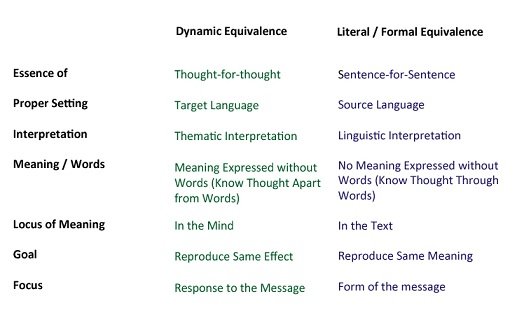
In response to this misleading charge, James D. Price noted: “The truth is that the KJV added the word ‘God’ in fifty one or more places where the Hebrew or Greek text did not contain it--and that without using italics in most cases. This was because the KJV used dynamic equivalence paraphrases such as ‘God forbid,’ ‘God save the king,’ or ‘God speed’ instead of a more literal expression in good English. In all these places the NKJV made the KJV more literal and more faithful to the Hebrew and Greek texts without undermining the place of God in the Bible” (False Witness of G. A. Riplinger's Death Certificate for the NKJV, p. 4). James D. Price then discussed these times and demonstrated the faithfulness of the NKJV to the Hebrew and Greek texts underlying the KJV.
 

Logos1560

Well-Known Member
Site Supporter
According to a consistent, just application of the measures/standards used by KJV-only advocates to attack the NKJV, would the KJV translators be condemned for omitting "thy God" at Deuteronomy 26:1 in the 1611 edition of the KJV?

David Norton wrote: "Without the evidence of Bod 1602 [the 1602 edition of the Bishops' Bible with the handwritten changes or revisions made by the KJV translators themselves], 1611's omission of 'thy God' would appear to be a simple omission by the printer. But the translators struck through 'thy God'" (Textual History of the KJB, p. 42). Concerning Deuteronomy 26:1, David Norton wrote: "1629 [Cambridge] follows B [Bishops] and G [Geneva]. 1611 appeared to be a printer's omission, but Bod shows that it goes back to the translators" (p. 224).

According to a consistent, just application of the measures/standards used by KJV-only advocates to attack the NKJV, would the KJV translators be condemned for omitting "of the LORD" at 2 Kings 11:10 in the 1611 edition of the KJV?

Concerning 2 Kings 11:10, David Norton wrote: "This looks like an omission by the translators but may be deliberate" (Textual History of the KJB, p. 242).
 

Logos1560

Well-Known Member
Site Supporter


Was it an enormously serious problem and an alarming inadequacy for the Church of England makers of the KJV to remove three whole verses at Psalm 14 that were found in the 1535 Coverdale's Bible, the 1539 Great Bible, and the 1602 edition of the Bishops' Bible?

Was it an enormously serious problem that the 1526 Tyndale's NT, the 1535 Coverdale's Bible, and the 1537 Matthew's Bible [three Bibles on the KJV-only view's pure stream of Bibles] did not have Mark 11:26, Luke 17:36, and Revelation 21:26 because those three verses were not in the Greek NT editions made by Erasmus?


Logos1560

Well-Known Member
Site Supporter

Table of Changes: Over 2,000 to Over 17,000 Changes.

Differs from the King James Bible in the New Testament

The number of times 15 Major words differ from the King James Bible
Does this claimed "table of changes" unintentionally reveal KJV-only reasoning as an unidentified one of the many varying editions of the King James Version would seem to be assumed to be the standard in and of itself, in effect assuming or making the textual criticism decisions and translation decisions in the KJV superior to the preserved Scriptures in the original languages? Was the KJV also assumed to be the standard in determining which words are considered "major" words?
 

Logos1560

Well-Known Member
Site Supporter
the Modern Bibles' omitting vital Bible Doctrinal words from the Bible which are essential characteristics that define Christianity, such as;
" damned
The 1895 Sunday School Teacher's Bible noted the following concerning "damnation, or condemnation" in its list of obsolete or ambiguous words in the KJV: "These words were used as equivalent terms when the A. V. was made." KJV-only author Jack Moorman wrote that “there is not a great deal of difference between ‘damnation’ and ‘condemnation.‘ As ‘damn’ comes from the Latin damnare, so ’condemn’ does also” (Conies, pp. 7-8). Concerning this word at 1 Timothy 5:12, Vincent commented: “It should be said for the translators of 1611 that they used damnation in this sense of judgment or condemnation, as is shown by the present participle having. In its earlier usage the word implied no allusion to a future punishment” (Word Studies, IV, p. 263).


Several of the early pre-1611 English Bibles had "damnation" at Luke 23:40, John 5:24, Romans 5:16, Romans 8:1, and James 3:1 while the KJV changes it to "condemnation." The 1535 Coverdale’s Bible has “damnation” (2 Cor. 3:9) where the KJV has “condemnation.” At James 5:9, the Geneva and KJV revised some of the early Bibles’ rendering “damned” to “condemned.“ Wycliffe’s Bible has “damned” (Matt. 12:37, Heb. 11:7) where the KJV has “condemned.” Wycliffe’s has “undamned” (Acts 16:37, 22:25) where the KJV has “uncondemned.“ Instead of “judgment,“ Whittingham’s and Geneva have “damnation” (Rev. 17:1). Tyndale’s, Coverdale’s, Matthew’s, and Great have “damnation” (Heb. 10:39) instead of “perdition.” At Romans 9:22, Philippians 3:19, and 2 Peter 2:1, Tyndale’s, Coverdale’s, Matthew’s, and Great Bibles have “damnation” while the KJV has “destruction.“


Would KJV-only advocates claim that the KJV omitted or removed a major doctrinal word, toned down or weakened the rendering of the pre-1611 English Bibles in any of these verses cited above? Does a consistent application of your own post suggest that the KJV omitted a vital Bible doctrinal word "damnation" at Luke 23:40, John 5:24, Romans 5:16, Romans 8:1, and James 3:1?
 
Top