All saved are the elect!Colossians 3:11-12, ". . . Where there is neither Greek nor Jew, circumcision nor uncircumcision, Barbarian, Scythian, bond nor free: but Christ is all, and in all. Put on therefore, as the elect of God, holy . . . ."

-
Welcome to Baptist Board, a friendly forum to discuss the Baptist Faith in a friendly surrounding.
Your voice is missing! You will need to register to get access to all the features that our community has to offer.
We hope to see you as a part of our community soon and God Bless!
You are using an out of date browser. It may not display this or other websites correctly.
You should upgrade or use an alternative browser.
You should upgrade or use an alternative browser.
N. T. Wright on Predestination and Election
- Thread starter Humble Disciple
- Start date
- Status
- Not open for further replies.

37818
Well-Known Member
No. That is not Biblical inerrancy. B. B. Warfield inclueded those subjects in his teaching on inerrancy. The quote from his book is online.
https://www.amazon.com/Inspiration-Authority-Bible-Warfield-BB/dp/B0011MN33W

Humble Disciple
Active Member
B. B. Warfield inclueded those subjects in his teaching on inerrancy.
I believe in sola scriptura and sola Christus, not sola Warfield.
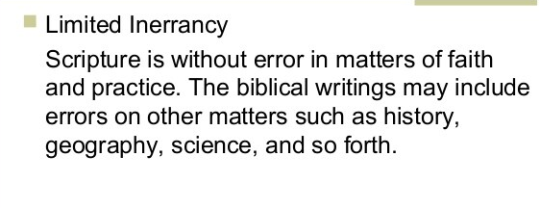
The limited inerrancy view offers room for the Bible to err in non-redemptive matters – matters that are not salvific by nature e.g. geographical, historical, scientific etc. The proponents of this view state that the main purpose of the Bible is “spiritual transformation” – to bring the lost man into a saving relationship with God. They then affirm that “If the Bible contains some errors, some discrepancies, that do not affect its power to transform lives through faith-filled communion with God, that is not important.” 3...
Bart Ehrman, the James A. Gray Distinguished Professor at the University of North Carolina at Chapel Hill, lost his faith in Christ because he apparently discovered one minor error in the gospels. It seemed Professor Ehrman held the doctrine of biblical inerrancy as the core of Christianity.
When a particular passage in the Gospel of Mark befuddled Bart Ehrman, his strong belief in inerrancy of the Bible was shaken. He became a liberal Christian and then ended up as an agnostic atheist after being unable to reconcile the philosophical problems of evil and suffering.
The Bible Has Errors, What Do We Do? - Christian Apologetics Alliance
First, we may need instead to revise our understanding of what constitutes an error. Nobody thinks that when Jesus says that the mustard seed is the smallest of all seeds (Mark 4.31) this is an error, even though there are smaller seeds than mustard seeds. Why? Because Jesus is not teaching botany; he is trying to teach a lesson about the Kingdom of God, and the illustration is incidental to this lesson. Defenders of inerrancy claim that the Bible is authoritative and inerrant in all that it teaches or all that it means to affirm. This raises the huge question as to what the authors of Scripture intend to affirm or teach. Questions of genre will have a significant bearing on our answer to that question. Poetry obviously is not intended to be taken literally, for example. But then what about the Gospels? What is their genre? Scholars have come to see that the genre to which the Gospels most closely conform is ancient biography. This is important for our question because ancient biography does not have the intention of providing a chronological account of the hero’s life from the cradle to the grave. Rather ancient biography relates anecdotes that serve to illustrate the hero’s character qualities. What one might consider an error in a modern biography need not at all count as an error in an ancient biography. To illustrate, at one time in my Christian life I believed that Jesus actually cleansed the Temple in Jerusalem twice, once near the beginning of his ministry as John relates, and once near the end of his life, as we read in the Synoptic Gospels. But an understanding of the Gospels as ancient biographies relieves us of such a supposition, for an ancient biographer can relate incidents in a non-chronological way. Only an unsympathetic (and uncomprehending) reader would take John’s moving the Temple cleansing to earlier in Jesus’ life as an error on John’s part.
We can extend the point by considering the proposal that the Gospels should be understood as different performances, as it were, of orally transmitted tradition. The prominent New Testament scholar Jimmy Dunn, prompted by the work of Ken Bailey on the transmission of oral tradition in Middle Eastern cultures, has sharply criticized what he calls the “stratigraphic model” of the Gospels, which views them as composed of different layers laid one upon another on top of a primitive tradition. (See James D. G. Dunn, Jesus Remembered [Grand Rapids, Mich.: William B. Eerdmans, 2003].) On the stratigraphic model each tiny deviation from the previous layer occasions speculations about the reasons for the change, sometimes leading to quite fanciful hypotheses about the theology of some redactor. But Dunn insists that oral tradition works quite differently. What matters is that the central idea is conveyed, often in some key words and climaxing in some saying which is repeated verbatim; but the surrounding details are fluid and incidental to the story.
Probably the closest example to this in our non-oral, Western culture is the telling of a joke. It’s important that you get the structure and punch line right, but the rest is incidental. For example, many years ago I heard the following joke:
“What did the Calvinist say when he fell down the elevator shaft?”
“I don’t know.”
“He got up, dusted himself off, and said, ‘Whew! I’m glad that’s over!’”
Now just recently someone else told me what was clearly the same joke. Only she told it as follows:
“Do you know what the Calvinist said when he fell down the stairs?”
“No.”
“‘Whew! I’m glad that’s over!’”
Notice the differences in the telling of this joke; but observe how the central idea and especially the punch line are the same. Well, when you compare many of the stories told about Jesus in the Gospels and identify the words they have in common, you find a pattern like this. There is variation in the secondary details, but very often the central saying is almost verbatim the same. And remember, this is in a culture where they didn’t even have the device of quotation marks! (Those are added in translation to indicate direct speech; to get an idea of how difficult it can be to determine exactly where direct speech ends, just read Paul’s account of his argument with Peter in Galatians 2 or of Jesus’ interview with Nicodemus in John 3.) So the stories in the Gospels should not be understood as evolutions of some prior primitive tradition but as different performances of the same oral story.
Now if Dunn is right, this has enormous implications for one’s doctrine of biblical inerrancy, for it means that the Evangelists had no intention that their stories should be taken like police reports, accurate in every detail. What we in a non-oral culture might regard as an error would not be taken by them to be erroneous at all.
What Price Biblical Errancy? | Reasonable Faith
The doctrine of unlimited inerrancy is a modern invention, and it has nothing to do with the essentials of Christian salvation.
"In Essentials Unity, In Non-Essentials Liberty, In All Things Charity."
Ecclesiastes 7:18
It is good to grasp the one and not let go of the other. Whoever fears God will avoid all extremes.
1 Corinthians 8:2-3
Anyone who claims to know all the answers doesn’t really know very much. But the person who loves God is the one whom God recognizes.
Last edited:
37818
Well-Known Member
Of an errant or inerrant God?believe in sola scriptura . . . .
You'll notice it doesn't say claim to be the elect of God. It's says act as the elect.Colossians 3:11-12, ". . . Where there is neither Greek nor Jew, circumcision nor uncircumcision, Barbarian, Scythian, bond nor free: but Christ is all, and in all. Put on therefore, as the elect of God, holy . . . ."
MB
You worship election then for me. I'll stay with Jesus Christ. Election is your gospel do you see the difference?If one was not elected by God, were not saved!
MB
The resurrection of Christ is the gospel. It's the real good news.He is good on the physical resurrection of Jesus, but that is about all good on!
MB
3:12 (NET)
3:12 Therefore, as the elect of God, holy and dearly loved, clothe yourselves with a heart of mercy, kindness, humility, gentleness, and patience,
Believers in Colossae are called the elect of God
3:12 Therefore, as the elect of God, holy and dearly loved, clothe yourselves with a heart of mercy, kindness, humility, gentleness, and patience,
Believers in Colossae are called the elect of God
This verse compares the elect to the Gentile. It's saying to be like the elect not be the elect KJV. You tell me I don't know scripture but even ignorant old me can read.3:12 (NET)
3:12 Therefore, as the elect of God, holy and dearly loved, clothe yourselves with a heart of mercy, kindness, humility, gentleness, and patience,
Believers in Colossae are called the elect of God
MB
37818
Well-Known Member
Well not merely "as" elect but "as" elect of God. It say this to both Jew and non-Jew. So to act fraudulently so or for real? To both Jew and non-Jew.You'll notice it doesn't say claim to be the elect of God. It's says act as the elect.
MB
1 Thessalonians 1:4–5: "Knowing, brethren beloved, your election of God. For our gospel came not unto you in word only, but also in power, and in the Holy Ghost, and in much assurance; as ye know what manner of men we were among you for your sake."
Wouldn't you agree that there is a difference in being elect and Gentile. You see we are to do as they do, not be them. There are Jews who are not electt.Well not merely "as" elect but "as" elect of God. It say this to both Jew and non-Jew. So to act fraudulently so or for real? To both Jew and non-Jew.
MB
37818
Well-Known Member
Well needless to say that word is used commonly 100's of times. Explain why the non elect shouldWouldn't you agree that there is a difference in being elect and Gentile. You see we are to do as they do, not be them. There are Jews who are not electt.
MB
act "as" God's elect? Since only the elect will be raptured, Matthew 24:29-31, 1 Corinthians 15:52.
All ever saved were the elect of God!You worship election then for me. I'll stay with Jesus Christ. Election is your gospel do you see the difference?
MB
the Cross of Christ is the Gospel!The resurrection of Christ is the gospel. It's the real good news.
MB
The election referenced in Ephesians 1:4 was corporate, God chose His Redeemer, His Lamb before the foundation of the world, and in so doing He corporately chose all those His Redeemer would redeem, i.e. the target group (believers) of His redemption plan.Please substantiate your claim.
Bearing False Witness is a Sin, A Warning of God's Judgment
Furthermore, you haven't addressed the actual issue, whether election is corporate or individual, according to the Bible.
However, during the physical lifetime of people, God individually chooses (individual election) them for salvation by setting them apart in Christ, i.e. the sanctification by the Spirit, and by reason of crediting their faith as righteousness, Romans 4:4-5, Romans 4:23-24, 2 Thessalonians 2:13.
Let me see what I can do.If you have specific quotes from N. T. Wright which demonstrate him contradicting scripture, please share them.
Wright is a very prolific writer. To summarize his work would need a book on its own. Therefore I'm picking on just one or two topics.
Wright is a supporter and popularizer of a chap called E.P. Sanders who wrote a book in 1977 called Paul and Palestinian Judaism. This book, and Wright's What Saint Paul really Said, impose upon the Bible what Sanders and Wright consider to be 1st Century Judaism, based on some of the discoveries in the Dead Sea Scrolls and on early Rabbinic and pseudepigraphical writings. They argue from these that Judaism was not based on works righteousness but on what Wright calls 'covenantal nomism.' which involved obedience to the law within the context of God's gracious covenant (contra Mark 7:1ff). Obedience to the law was not thought of as the way into the covenant, but the way of staying in it..
Part of the problem with all this is that it cuts across texts like Exodus 19:5 where the covenant is clearly conditional (compare with 1 Peter 2:9-10), and Romans 10:3, where Paul declares that the Jews were ignorant of God's righteousness and were seeking to establish their own. Also, Don Carson and Mark Seifrid have examined the evidence of the Dead Sea Scrolls and found that 'One could only be clean from sin by belonging to the community and observing their strict regulations' (Seifrid). And I attended a lecture by Sam Waldron back around 2,000 in which he quoted from a number of rabbinic authors, showing that according to them, men like Abraham, Moses and Ezra were approved and heard by God because of their ethical righteousness rather than by grace through faith (contra Romans 4:3 & Hebrews 11:24ff).
There's much more to say, but the gist of the whole thing is that Wright is imposing a view of 1st Century Judaism upon Christianity rather than following the Bible. At best that view is disputed; at worst it is dead wrong.
Humble Disciple
Active Member
There's much more to say, but the gist of the whole thing is that Wright is imposing a view of 1st Century Judaism upon Christianity rather than following the Bible. At best that view is disputed; at worst it is dead wrong.
Without an actual quote of Wright himself, there's nothing I can respond to.
Have you read the book Jesus: Two Visions by N. T. Wright and Marcus Borg, in which Wright defends the traditional understanding of Jesus?
Humble Disciple
Active Member
The New Testament term for the church "ekklesia," which is related to the English word "elect," was also used for the people of Israel in the Greek Septuagint.
The Corporate View of Election
The Corporate View of Election
- Status
- Not open for further replies.