
• Welcome to Baptist Board, a friendly forum to discuss the Baptist Faith in a friendly surrounding.

    Your voice is missing! You will need to register to get access to all the features that our community has to offer.

    We hope to see you as a part of our community soon and God Bless!

N. T. Wright on Predestination and Election

Status
Not open for further replies.

Martin Marprelate

Well-Known Member
Site Supporter
Without an actual quote of Wright himself, there's nothing I can respond to.

Have you read the book Jesus: Two Visions by N. T. Wright and Marcus Borg, in which Wright defends the traditional understanding of Jesus?
No I haven't. Wright's literary corpus is huge. The book I have read which is still in my possession is What Saint Paul really said. It is this book that I consider to be unsound.
Wright's understanding of the Person of the Lord Jesus is sound SFAIK. It is his understanding of Justification with which I take issue. Luther wrote that Justification is the doctrine on which the Church stands or falls.
 

Martin Marprelate

Well-Known Member
Site Supporter
The New Testament term for the church "ekklesia," which is related to the English word "elect," was also used for the people of Israel in the Greek Septuagint.

The Corporate View of Election
I think this is a stretch. eklektos comes from the verb eklego, which means 'to pick out; or ;to choose.'
ekklesia may be connected with the verb ekkaleo, which means 'to summon forth' or 'to call out.' ekklesia simply has the meaning of an assembly and so it is used hundreds of times in Classical Greek.. It is used three times in Acts 19 to describe the city council in Ephesus, and the law court in that city.

'Many are called but few are chosen' Matthew 20:16.
 

kyredneck

Well-Known Member
Site Supporter
the actual issue, whether election is corporate or individual, according to the Bible.

...according to the Bible, INDIVIDUALS (pronouns tell the story):

29 For whom he foreknew, he also foreordained to be conformed to the image of his Son, that he might be the firstborn among many brethren:
30 and whom he foreordained, them he also called: and whom he called, them he also justified: and whom he justified, them he also glorified. Ro 8

15 For he saith to Moses, I will have mercy on whom I have mercy, and I will have compassion on whom I have compassion.
16 So then it is not of him that willeth, nor of him that runneth, but of God that hath mercy.
18 So then he hath mercy on whom he will, and whom he will be hardeneth.
19 Thou wilt say then unto me, Why doth he still find fault? For who withstandeth his will?
20 Nay but, O man, who art thou that repliest against God? Shall the thing formed say to him that formed it, Why didst thou make me thus? Ro 9
 
Last edited:

Iconoclast

Well-Known Member
Site Supporter
...according to the Bible, INDIVIDUALS (pronouns tell the story):

29 For whom he foreknew, he also foreordained to be conformed to the image of his Son, that he might be the firstborn among many brethren:
30 and whom he foreordained, them he also called: and whom he called, them he also justified: and whom he justified, them he also glorified. Ro 8

15 For he saith to Moses, I will have mercy on whom I have mercy, and I will have compassion on whom I have compassion.
16 So then it is not of him that willeth, nor of him that runneth, but of God that hath mercy.
18 So then he hath mercy on whom he will, and whom he will be hardeneth.
19 Thou wilt say then unto me, Why doth he still find fault? For who withstandeth his will?
20 Nay but, O man, who art thou that repliest against God? Shall the thing formed say to him that formed it, Why didst thou make me thus? Ro 9
For whatever reasons many would rather deny truth than submit to it. You could not write it clearer.
 

Yeshua1

Well-Known Member
Site Supporter
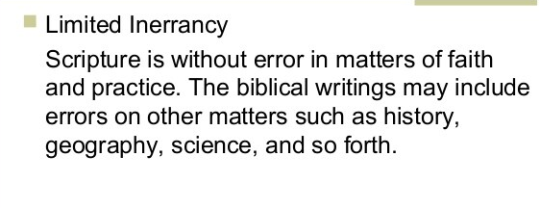
Biblical Inerrancy vs. Biblical Infallibility

4cda8f0b4db193e82589a2fc3a7940a8d5e25a48.png
There have been found no historical or scientific errors in the Bible, just issues mainly with numbers cited in OT texts!
 

Yeshua1

Well-Known Member
Site Supporter
I believe in sola scriptura and sola Christus, not sola Warfield.


The doctrine of unlimited inerrancy is a modern invention, and it has nothing to do with the essentials of Christian salvation.

"In Essentials Unity, In Non-Essentials Liberty, In All Things Charity."

Ecclesiastes 7:18
It is good to grasp the one and not let go of the other. Whoever fears God will avoid all extremes.

1 Corinthians 8:2-3
Anyone who claims to know all the answers doesn’t really know very much. But the person who loves God is the one whom God recognizes.
From the very beginning, Christians saw the scriptures to all be inspired and trustworthy!
 

Yeshua1

Well-Known Member
Site Supporter
Let me see what I can do.
Wright is a very prolific writer. To summarize his work would need a book on its own. Therefore I'm picking on just one or two topics.
Wright is a supporter and popularizer of a chap called E.P. Sanders who wrote a book in 1977 called Paul and Palestinian Judaism. This book, and Wright's What Saint Paul really Said, impose upon the Bible what Sanders and Wright consider to be 1st Century Judaism, based on some of the discoveries in the Dead Sea Scrolls and on early Rabbinic and pseudepigraphical writings. They argue from these that Judaism was not based on works righteousness but on what Wright calls 'covenantal nomism.' which involved obedience to the law within the context of God's gracious covenant (contra Mark 7:1ff). Obedience to the law was not thought of as the way into the covenant, but the way of staying in it..

Part of the problem with all this is that it cuts across texts like Exodus 19:5 where the covenant is clearly conditional (compare with 1 Peter 2:9-10), and Romans 10:3, where Paul declares that the Jews were ignorant of God's righteousness and were seeking to establish their own. Also, Don Carson and Mark Seifrid have examined the evidence of the Dead Sea Scrolls and found that 'One could only be clean from sin by belonging to the community and observing their strict regulations' (Seifrid). And I attended a lecture by Sam Waldron back around 2,000 in which he quoted from a number of rabbinic authors, showing that according to them, men like Abraham, Moses and Ezra were approved and heard by God because of their ethical righteousness rather than by grace through faith (contra Romans 4:3 & Hebrews 11:24ff).

There's much more to say, but the gist of the whole thing is that Wright is imposing a view of 1st Century Judaism upon Christianity rather than following the Bible. At best that view is disputed; at worst it is dead wrong.
and THAT error is the very foundation he uses to state that Pauline Justification as Reformers held to was and is dead wrong!
 

Yeshua1

Well-Known Member
Site Supporter
Without an actual quote of Wright himself, there's nothing I can respond to.

Have you read the book Jesus: Two Visions by N. T. Wright and Marcus Borg, in which Wright defends the traditional understanding of Jesus?
His big error is not in who Jesus is, but what the Gospel is!
 

Yeshua1

Well-Known Member
Site Supporter
No I haven't. Wright's literary corpus is huge. The book I have read which is still in my possession is What Saint Paul really said. It is this book that I consider to be unsound.
Wright's understanding of the Person of the Lord Jesus is sound SFAIK. It is his understanding of Justification with which I take issue. Luther wrote that Justification is the doctrine on which the Church stands or falls.
Paul so clear to all but NT Wright, as Ge stated that Israel sought to be justified by the Law!
 

JonC

Moderator
Moderator
N.T. Wright is orthodox. That does not mean he is correct.

And the OP is correct in a way (N.T. Wright was the "gold standard" of Pauline theology among the evangelicals and Reformed....until he wasn't...i.e., until he said that they, including himself, had made errors regarding how Paul viewed righteousness in relation to the Law).
 
Status
Not open for further replies.
Top